
Tree Removal Permits in Clermont, FL: The Quick Version
If your home is inside Clermont city limits, start from the assumption that a permit is required. Section 118-111 of the city's Land Development Code makes it unlawful to clear or remove a tree by any method without first getting a permit, unless the removal is exempted elsewhere in the code. The city's application form spells it out in capital letters: do not remove any trees until the permit is approved.
The big exception comes from state law. Under Florida Statute 163.045, a city or county cannot require a permit, fee or replanting for removing a tree at a single-family home when the owner has proper documentation that the tree poses an unacceptable risk. More on exactly what that documentation must be below, because the wording matters.
If you live outside city limits, in unincorporated Lake County, or in a neighboring city like Minneola or Groveland, the city of Clermont's rules do not apply to you. Each jurisdiction has its own code.
How the Clermont Tree Removal Permit Works
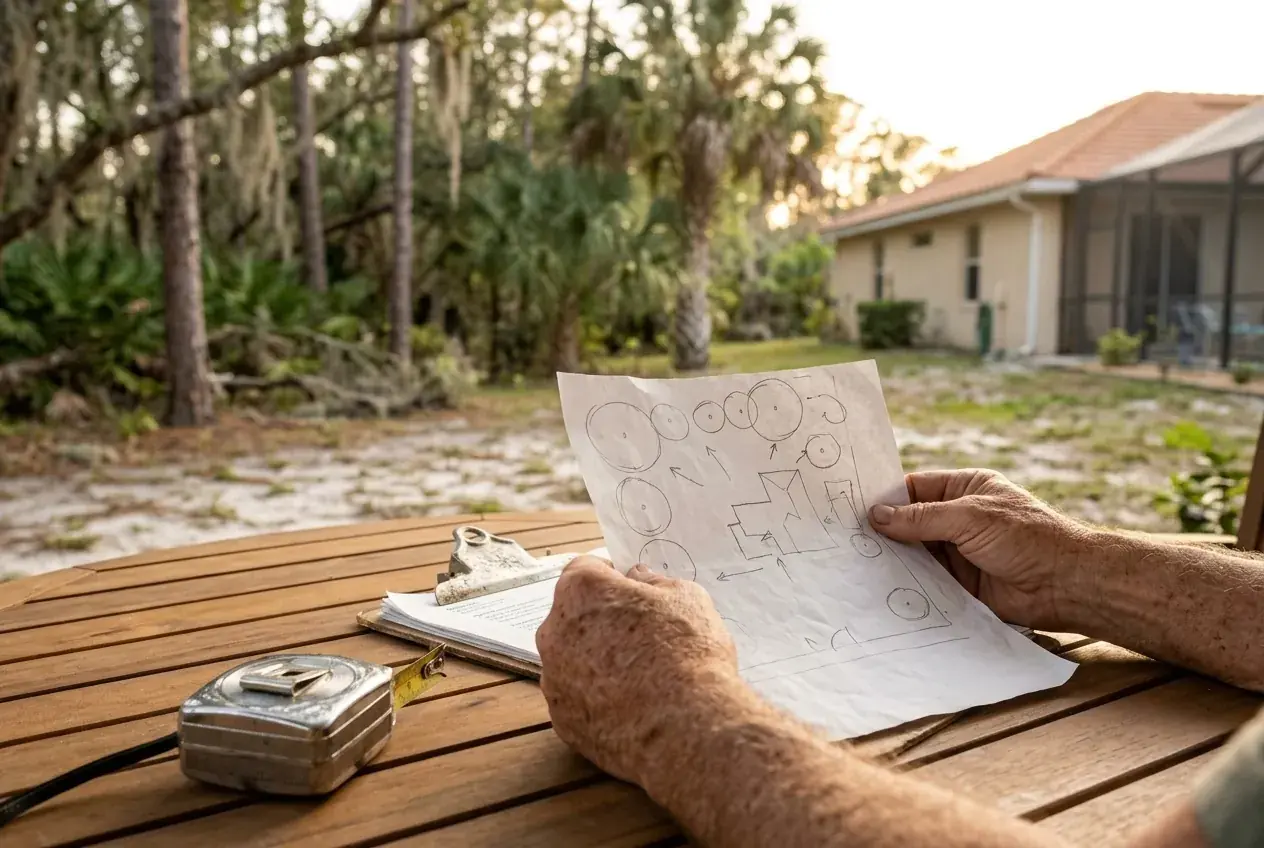
The city's tree removal permit application, dated March 2023, asks for the owner's contact details, the property's alternate key and subdivision, the reason for removal, and the number of trees to be removed along with their type if you know it. You attach a property survey or a sketch showing where the trees are, and city staff come out to inspect.
The city's own FAQ describes the site plan as showing the location of canopy, understory and palm trees and marking which ones are coming out. It also says the Building Department decides whether replacement trees are needed, based on lot size and how many trees you have.
| Item | What the city form and code say |
|---|---|
| Code section | Land Development Code Sec. 118-111 (permit required); Sec. 118-113 (criteria and replacement) |
| Regular fee | $25.00, per the 2023 application |
| After-the-fact fee | $155.00 if a tree was removed before a permit was issued |
| What to attach | A property survey or sketch showing tree locations |
| Inspection | City staff inspect before approval |
| Debris | Owner or contractor must remove it; the city will not pick up debris from a permitted removal |
Fees and forms change, so treat those numbers as a starting point and confirm them with the city's planning or building staff before you apply. We check the current requirement on every Clermont estimate.
Clermont Tree Permit Criteria: When the City Approves Removal
Section 118-113 lists the general reasons the city will authorize removing a protected tree. In plain terms, approval is tied to showing that at least one of these applies:
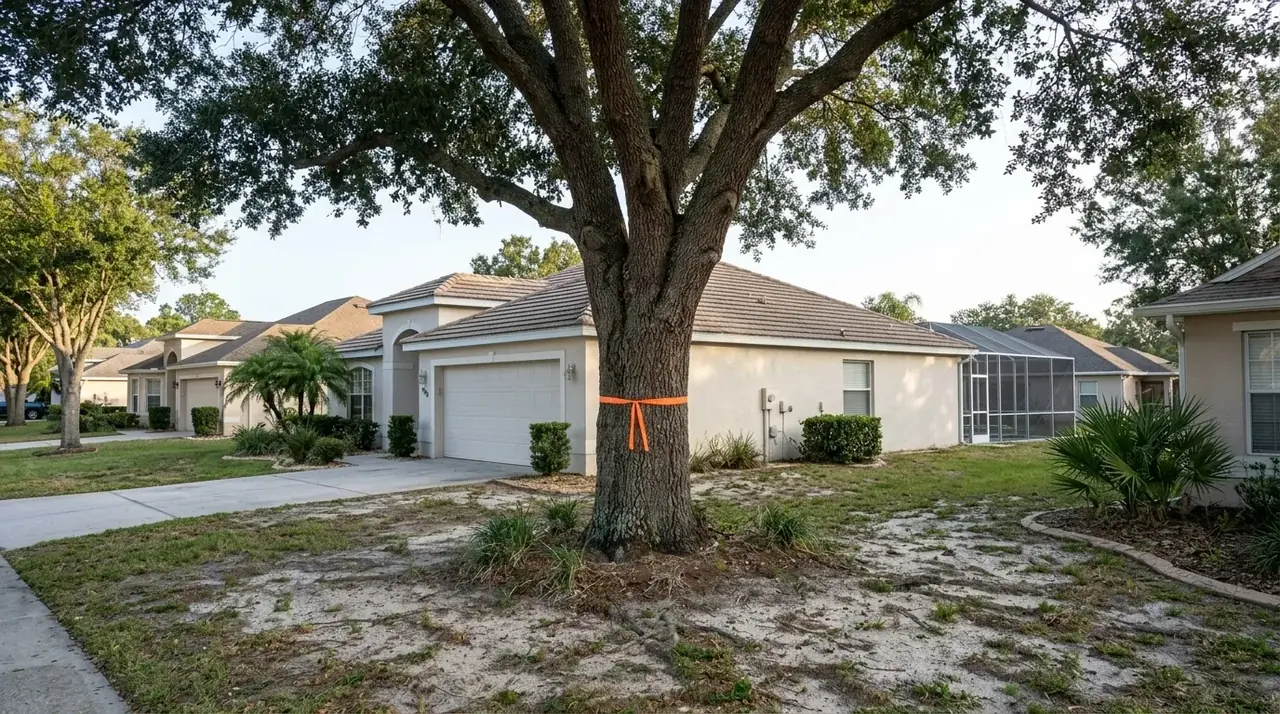
- A permitted use of the site cannot reasonably happen unless the tree comes out.
- The tree is close enough to an existing or proposed structure that the building's safety or integrity is materially impaired.
- It interferes with utility lines or services.
- It creates a real hazard to cars, bikes or people walking by, from its position or by blocking sight lines.
- It is diseased or weakened by age, abuse, storm or fire and is likely to cause injury or damage.
- Another law or regulation requires its removal.
The code also lists more specific situations, including a tree that is dead or dying so that restoring it is not practical, or one carrying a disease likely to spread to other trees. For a single-family lot, the replacement section says a tree removed because it is dead, diseased, dying or too close to a structure is to be replaced with a new tree meeting the city's planting standard. That replanting requirement is one of the things state law can override, which brings us to the dangerous-tree statute.
Florida's Dangerous Tree Law and Clermont Homeowners
Florida Statute 163.045 was created in 2019 and amended in 2022. It applies to residential property, which the statute defines as a single-family, detached building on a lot actively used as a single-family home. Townhomes, condos and commercial lots fall outside it.
The key requirement is documentation. The statute defines that as an onsite tree risk assessment, done under the International Society of Arboriculture's 2017 Best Management Practices for tree risk assessment, and signed by either an ISA certified arborist or a Florida licensed landscape architect. The tree must pose an unacceptable risk, which the statute defines as a situation where removal is the only practical way to bring the risk below moderate.
If you have that documentation, the city or county cannot require notice, an application, approval, a permit, a fee or mitigation for pruning, trimming or removing the tree, and it cannot require you to replant. A note from a tree company saying the tree looks bad is not the same thing. Neither is a photo. The signed risk assessment is what carries the legal weight, so keep a copy with your property records.
Lake County Tree Removal Rules for Unincorporated Areas
Homes outside any city, including many rural lots around Clermont and Montverde, fall under the Lake County Land Development Regulations, Section 9.02, Tree Protection. The county designates protected trees by type and size. Those include native or Florida-Friendly trees and palms 3 inches or more in diameter at breast height, sand pine and xeric oak scrub trees 2 inches or more, wetland trees of any size, and designated specimen and heritage trees. Citrus and other non-native fruit trees are not protected trees under the county code.
The county's exemptions are generous for most homeowners. Trees on a single-family residential lot of two acres or less that contains a home are exempt from the tree removal permit, apart from trees the county counts toward minimum landscaping requirements, and the code places a cumulative caliper limit on other removals over a three-year period. The county code also cross-references Florida Statute 163.045 for dangerous trees on residential property.
In early 2026, Lake County's planning staff brought forward an ordinance amending Section 9.02 to tighten protection of heritage and specimen trees, mainly as they relate to development projects. If you own a large acreage parcel or are planning to build, call the county's planning and zoning office for the version currently in force.
Tree Permit Rules in Minneola, Groveland and Orange County
Every city around South Lake writes its own tree code, and west Orange County adds another layer. Homes in Winter Garden, Ocoee and Windermere follow those cities' rules, while Horizon West and Gotha fall under unincorporated Orange County. We have not summarized each code here because the details change and we would rather you hear the current version from the source.
What does not change from town to town is the state statute. For a qualifying single-family home with a properly documented dangerous tree, 163.045 applies everywhere in Florida except the narrow mangrove-protection carve-out, which does not affect inland Lake County.
HOA Rules and Clermont Tree Removal
The state law limits what local governments can require. It says nothing about homeowners associations. Many subdivisions around Clermont have covenants requiring architectural review before removing or replacing a tree, especially in front yards. Check your HOA documents before scheduling work, and get any approval in writing.
How We Handle Tree Removal Permits in Clermont
On every estimate we look up which jurisdiction your parcel falls in and tell you what that office requires. If a permit is needed, we tell you before work is scheduled, and we do not start cutting until it is approved. If the tree is dead or clearly failing, we explain the documentation route under state law so you can decide how to proceed.
Once the paperwork is sorted, the removal itself works the same as any other job. Our tree removal service covers the cutting, cleanup and haul-off, and stump grinding can be added if you plan to replant. If the tree only needs a few limbs taken back, tree trimming and pruning may avoid the permit question entirely, though some local codes still regulate heavy pruning. For a sense of the budget, see our guide to tree removal costs in Clermont.