
Service · Clermont, FL
Storm Damage Cleanup in Clermont, FL
After a hurricane or tropical storm, the yard rarely has just one problem. We clear hanging limbs, take down uprooted and split trees, photograph everything for your claim, and either haul the debris or stack it to meet curbside pickup rules.
Storm Damage Cleanup Clermont Homeowners Can Plan Around
When Hurricane Ian crossed Central Florida in 2022, and again after Milton in 2024, the damage around Lake County didn't look like one dramatic fallen tree. It looked like a dozen smaller problems in every yard: limbs snapped and hanging in the canopy, a pine leaning at a new angle, an oak tipped over with its roots in the air, and a pile of debris nobody could move alone. That's the work this service covers.
Storm cleanup is different from a single emergency tree removal. Emergencies are about stopping damage right now. Cleanup is the bigger job that follows, usually a day to a few weeks after the storm, where we make every tree on the property safe, document it for insurance, and leave the yard ready for normal life again.
What Storm Damage Tree Cleanup Includes
- A walk-through of every tree on the property, not just the obvious ones
- Removal of hangers, broken limbs caught in the canopy that can fall days later
- Takedown of uprooted, split, or newly leaning trees
- Corrective pruning on damaged trees that are worth keeping
- Dated photos and an itemized invoice for your insurance file
- Debris haul-off, or cutting and stacking it to meet curbside collection rules
- Follow-up stump grinding and root-plate cleanup
The limbs that hurt people after a storm are usually the ones that didn't fall. A broken branch wedged in the upper canopy can hang there for a week and then drop in a light breeze, often onto a driveway or play area where people assume the danger has passed. We treat hangers as the first priority on every cleanup, and we'll mark off areas of the yard to avoid until they're down.
Storm-Damaged Trees in Lake County's Sandy Soil
Clermont's ridge sand is a strange thing in a hurricane. It drains so well that trees here grow broad, shallow root systems instead of deep anchors. When a slow-moving storm dumps several inches of rain and then pushes wind for hours, that sand turns soft and the whole root plate can rotate out of the ground. You'll see a disc of roots and soil standing on edge where the tree used to be.
Trees that partially tipped are the tricky ones. A tree leaning a few degrees more than it did before the storm may have broken roots on the far side, even if the canopy looks fine. Look for raised or cracked soil opposite the lean. If you see it, that tree usually needs to come down, especially on a slope. Our article on trees on Clermont's hills and sandy soil explains how slope and soil type change the risk.
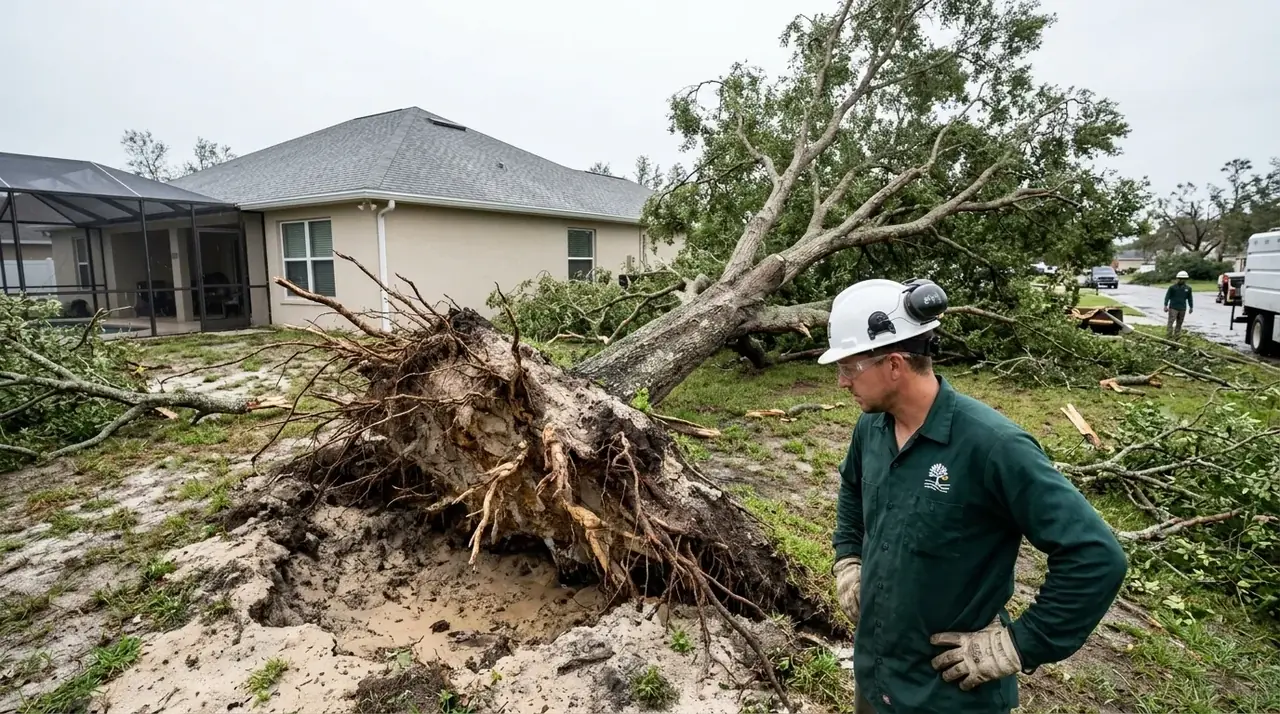
Pines and palms behave differently from oaks after a storm. A pine can look untouched yet have a twisted trunk or cracked bark from flexing, and those wounds attract bark beetles within weeks, so we keep an eye on any pine near a house for the rest of the season. Palms usually shed fronds and survive, though a sabal that lost its bud or a queen palm with a kinked trunk won't recover. Broken fronds left hanging should come down before they drop.
Not every damaged tree is a loss, though. A live oak that lost a few limbs but has a sound trunk and roots usually recovers well with careful pruning to clean up the torn ends. We'll sort trees into keep, prune, and remove so you aren't paying to take down anything that would have bounced back.
Storm Cleanup Cost in Clermont, FL
Storm cleanup is usually priced as a single job for the whole property rather than tree by tree, because crews, chippers, and trucks are set up once. Here are typical ranges we see around South Lake County.
| Job | Typical range | What moves the price |
|---|---|---|
| Hanger and broken-limb removal | $250 – $900 | Height of the hangers, number of trees, climbing vs. lift |
| Uprooted small or medium tree | $500 – $1,800 | Trunk size, root plate, access for equipment |
| Uprooted or split large tree | $1,800 – $3,500+ | Wood weight, nearby structures, crane need |
| Debris haul-off only | $300 – $1,200 per load | Volume, how far it has to be carried to the truck |
| Cut and stack for curbside pickup | $200 – $700 | Amount of material, sorting needed |
| Root-plate and stump cleanup | $150 – $600 each | Size of the root disc, backfill sand required |
Insurance Documentation for Storm Damage
We photograph every damaged tree before cutting, with wide shots that show the tree's relation to the house and close-ups of breaks, roots, and anything it hit. You get those photos the same day along with an itemized invoice that separates trees on structures from trees that fell in open yard. That split matters, because many homeowners policies treat them very differently. Check your policy for how it handles tree debris removal, and ask your adjuster before you assume something isn't covered.
Debris Rules for Lake County Curbside Pickup
After major storms, Lake County and the cities run debris collection with specific rules. During the Milton cleanup, residents were asked to keep vegetative debris (limbs, trunks, leaves, stumps) separate from construction debris like roofing, drywall, and fencing, and not to bag vegetative material. Piles also need to stay clear of mailboxes, driveways, fire hydrants, utility poles, and storm drains, and off the road itself.
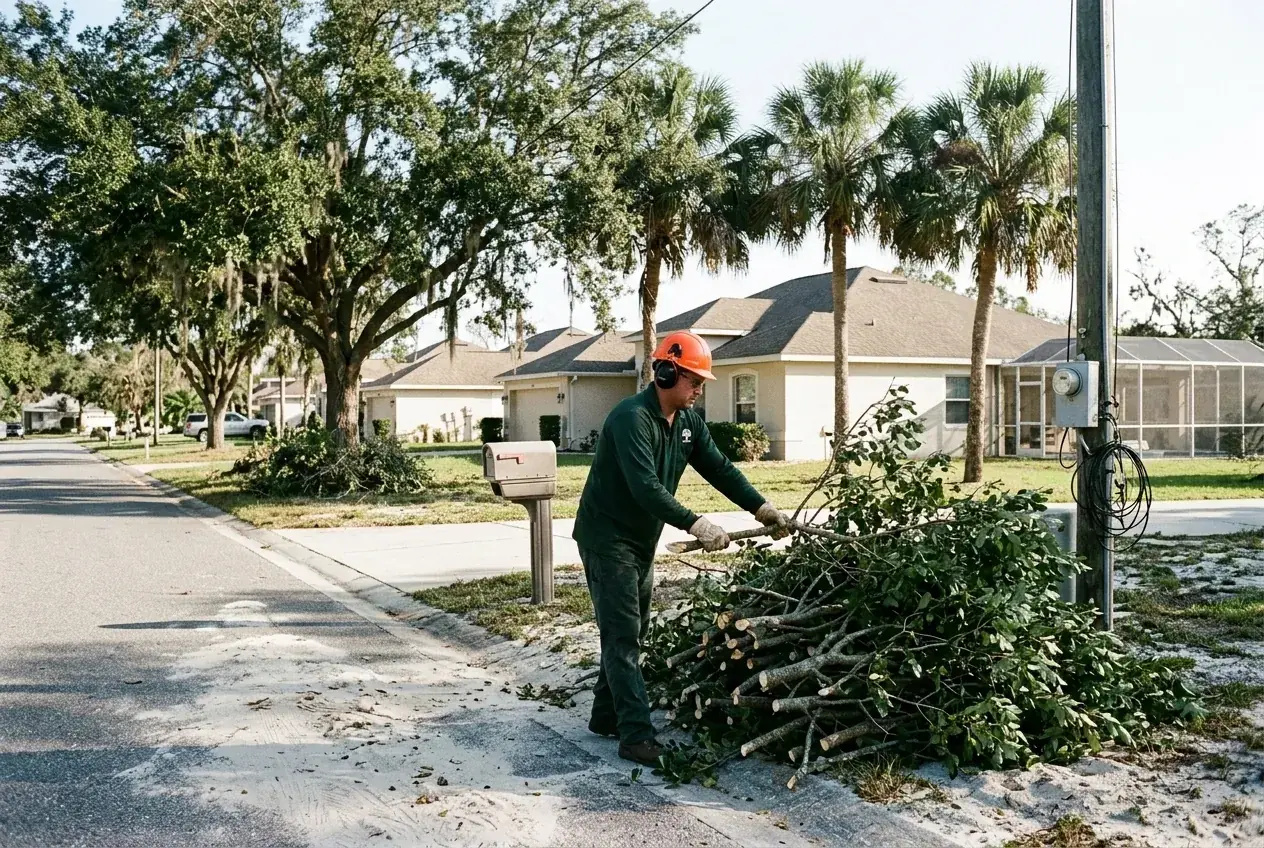
Every event has its own deadlines and details, and cities like Clermont and Minneola may run their own schedules apart from unincorporated Lake County. Check your city or county website after each storm. We'll stack material to whatever rules apply at the time, or haul it away if you'd rather not wait for the trucks.
Avoiding Storm-Chaser Tree Crews
Every hurricane brings out-of-state crews knocking on doors with cash deals. Some do fine work. Others take a deposit, drop a tree on a fence, and disappear. A few sensible checks protect you:
- Ask for proof of liability insurance and workers' compensation coverage, and call the insurer to confirm it's active
- Get the price in writing before work starts, with what's included spelled out
- Be wary of large up-front deposits, especially cash
- Read any paper that hands your insurance claim to the contractor; Florida's recent insurance reforms restricted those assignment agreements on newer policies, so ask your insurer before signing one
- Report price gouging during a declared state of emergency to the Florida Attorney General
We're a local Clermont company. We'll still be here next month when the insurance check arrives, and next season when the next storm shows up.
In the first days after a big storm, we work through emergencies first: trees on homes and blocked roads. General cleanup gets scheduled as those clear, and most properties are handled within one to three weeks depending on how widespread the damage is. A typical yard with a few hangers and one or two fallen trees takes a single day. Heavier properties with several large uprooted trees can take two or three. Stump grinding usually follows once the debris is gone and equipment can reach the stumps.
Hurricane Tree Cleanup Across South Lake County
We handle post-storm cleanup in every town we serve, including Minneola, Howey-in-the-Hills, Groveland, and Ocoee. The best time to reduce cleanup is before the storm, and our hurricane tree prep checklist shows what to look for each spring. When the next storm passes, get on our list early and we'll give you an honest timeline.
Questions
Storm Damage Cleanup Questions From Clermont Homeowners
Trees on occupied homes and blocked access come first, often the same day or the next. General cleanup, like hangers, fallen trees in the yard, and debris, is scheduled as those emergencies clear. After a widespread storm like Ian or Milton, that can mean one to three weeks. Call early to get on the list, and send photos so we can rank your job correctly and give you a real date.
A hanger is a broken limb that's caught in the tree's canopy instead of falling to the ground. It can stay there for days and then drop without warning, often when people are walking or parking underneath. Hangers are a leading cause of injuries during storm cleanup. We remove them first on every job, and we suggest keeping kids and cars out from under damaged trees until then.
Sometimes. Many policies pay to remove a tree that damaged a covered structure, and some include a limited allowance for debris from trees that fell in the yard without hitting anything. Others don't cover yard-only trees at all. It depends entirely on your policy, so ask your insurer directly. Our photos and itemized invoice separate the two categories, which makes the claim easier to process.
Not vegetative debris. During recent Lake County storm cleanups, residents were told that bagged limbs and leaves wouldn't be collected with the loose storm debris. Keep branches, trunks, and leafy material in loose piles, separate from construction debris like shingles or fence panels. Rules can change for each storm, so check your city or county announcements, and we'll stack everything to match them.
A small tree that tipped slightly can sometimes be pulled upright and staked if the roots are mostly intact. A large tree that's leaning more than it used to, especially with cracked or heaved soil on the opposite side, usually has broken anchor roots and won't stabilize. In Clermont's sandy soil, those trees tend to keep moving. We'll look at the root zone and tell you which group yours falls in.
Be cautious with crews that knock on doors unannounced, want cash or a big deposit, can't show proof of insurance, or push you to sign over your insurance claim. Ask for a written price, look up the business, and call its insurance carrier to verify coverage. If you're quoted a price that seems wildly inflated during a declared emergency, you can report it to the Florida Attorney General's office.
Yes. When the county or your city is running storm debris collection, we can cut everything into manageable lengths and stack it neatly at the curb, away from mailboxes, poles, hydrants, and drains. That costs less than hauling because you aren't paying for truck loads and disposal. If collection deadlines are close or the trucks are running behind, we can switch to hauling it away instead.
When a tree tips over, the root plate pulls a big disc of sand out of the ground and leaves a crater. After we cut the trunk off, we can grind or cut down the root plate, push the soil back into the hole, and add fill sand if needed so it's level. Leaving the crater open is a tripping hazard and collects standing water during the rainy season.
Yes, and those are often the most important ones. A split trunk, a torn-off leader, or a tree with half its crown gone can be a bigger hazard than one already on the ground. We assess every damaged tree, prune the ones that can recover, and remove the ones that can't. You'll get a clear explanation for each tree before we do any work on it.
Usually per job. After a storm, most yards have a mix of hangers, broken limbs, and one or two fallen or split trees, and setting up crews and equipment once is more efficient. We walk the whole property and give you one written price covering everything we agreed to do. If you want to handle part of the cleanup yourself, we can price only the pieces you need.
Related
Other tree work we do
Storm cleanup, documented properly
We photograph the damage for your adjuster, make it safe, then clean it up.
Mon–Sat 7:00am–7:00pm (24/7 emergency line for storm work) · Licensed & insured