
Why Laurel Oaks Fail in Central Florida: The Short Version
Laurel oak, Quercus laurifolia, is a fast-growing native oak that reaches 60 to 70 feet tall. The University of Florida's fact sheet on the species puts its typical lifespan at 50 to 70 years and notes that it tends to hollow with age as it approaches 50. UF/IFAS hurricane research goes a step further, describing a typical laurel oak lifespan of about 50 years with decay and disease often showing up around age 40.
Plenty of laurel oaks in Clermont were planted or sprouted when the surrounding land was cleared for neighborhoods, which puts many of them squarely in that decline window today. Fast growth gives you shade quickly. The trade-off is wood that does not hold up as well, and a tree that does not seal off injuries well.
Laurel Oak Decay: What Happens Inside the Trunk
The UF/IFAS fact sheet warns that even small trunk wounds or poor pruning cuts on laurel oak can lead to columns of decay inside the trunk 10, 20 or more feet long. Those columns are invisible from outside until they are well advanced. The tree can keep a full green canopy while the structural wood holding that canopy up is being eaten away.
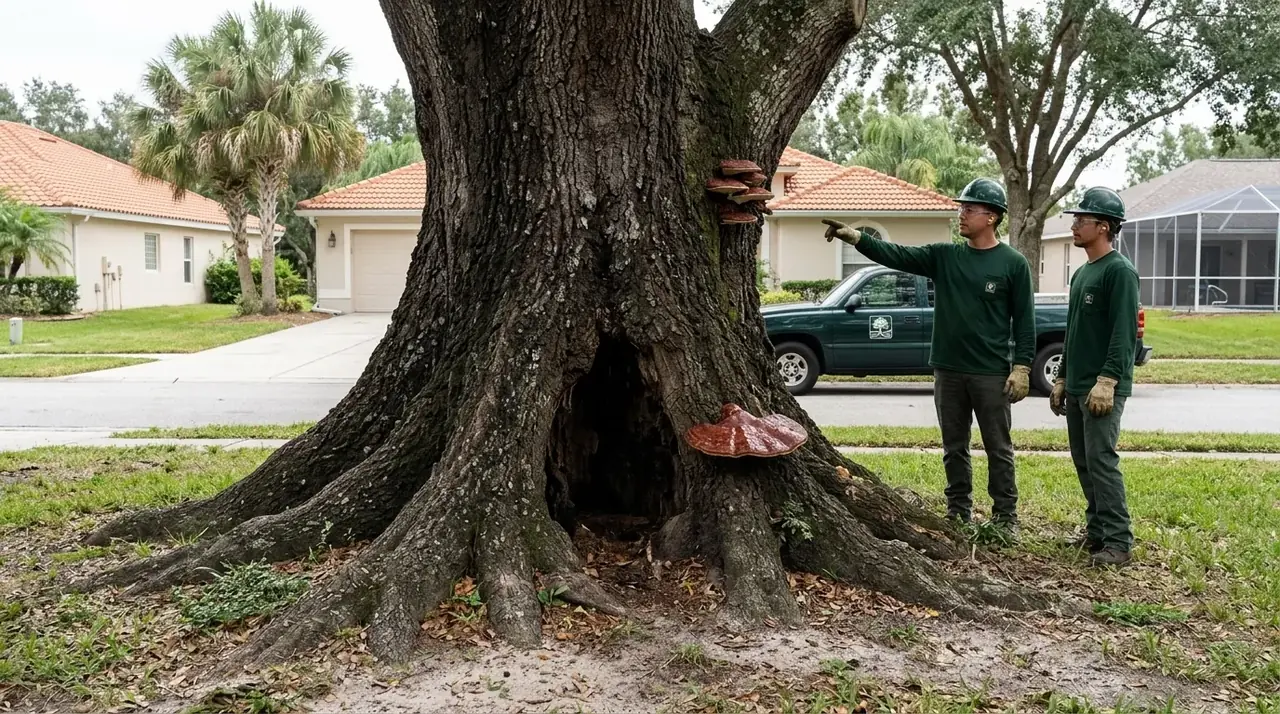
Wood-decay fungi do that work. A Florida Forest Service and University of Florida guide to decay in Florida trees shows laurel oak decay caused by Inonotus rickii, and notes that Biscogniauxia, a fungus that shows up as dark crusty patches, is very common on declining or dead oaks in Florida, especially after drought and heat stress. UF/IFAS also describes laccate Ganoderma species, which produce shiny, reddish-brown shelf-like conks and can rot roots and lower trunks.
Heart rot vs. root rot
Heart rot attacks the center of the trunk and major limbs. A tree with heart rot often breaks partway up, dropping a big limb or snapping the top out. Root and butt rot work underground and at the trunk base, and those trees are more likely to tip over whole, root plate and all, often in wet weather or wind. Both show up in laurel oaks.
Why pruning cuts matter so much on laurel oak
Because laurel oak compartmentalizes decay poorly, the way it is pruned has an outsized effect on how long it stays sound. Flush cuts that remove the branch collar, ragged storm breaks left untreated, and topping cuts through big limbs all open the door to fungi. A clean cut just outside the collar, made on a branch small enough to close over, gives the tree its best chance. That is also why we avoid removing large live limbs from mature laurel oaks unless there is a clear reason.
Lawn equipment does damage too. Repeated string-trimmer and mower strikes at the trunk base create the kind of small, constant wounds the UF/IFAS fact sheet warns about. A ring of mulch around the base keeps machines away and costs almost nothing.
Warning Signs of a Failing Laurel Oak in Clermont
You do not need special tools to spot most of the red flags. Walk around the tree and look up and down.
- Conks or mushrooms on the trunk, at the root flare or on surface roots. UF/IFAS notes that fruiting bodies mean the decay is active.
- Cavities, open seams or cracks running along the trunk.
- Bulges or butt swell near the base, which can mean the tree is adding wood around internal decay.
- Dead branches in the upper crown, or large branch stubs left from old storm breaks.
- Two equal-sized trunks splitting from the same point, especially with bark pinched between them.
- Fresh sawdust-like material or carpenter ants around old wounds.
- Soil heaving or cracking on one side of the tree after rain, which can signal root failure.
One sign alone does not mean the tree must come down. Several together, on a tree that is 40 or more years old and leaning over your house, usually do.
Laurel Oak vs. Live Oak: How to Tell Them Apart
The two get confused constantly, and the difference matters. UF/IFAS rates live oak among the most wind-resistant trees in the Southeast and says a well-located one can live for centuries. Laurel oak is on the lowest wind-resistance list. Here is how to tell which one is shading your yard.
| Feature | Laurel oak vs. live oak |
|---|---|
| Crown shape | Laurel: oval to round, taller than wide, about 60-70 ft tall by 35-45 ft wide. Live oak: broad and spreading, often 60-80 ft tall and 60-120 ft wide. |
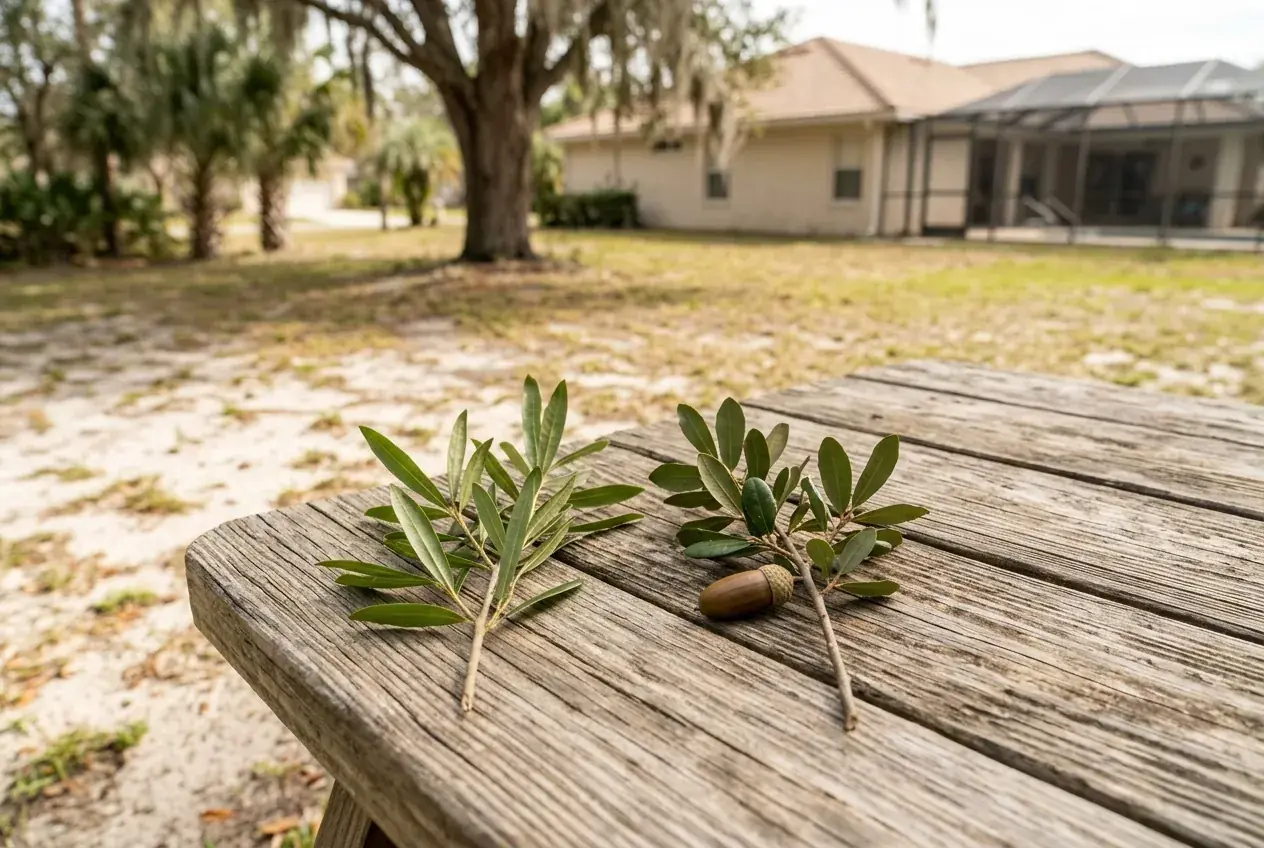
| Leaves | Laurel: thin, glossy, 3 to 5 inches long. Live oak: often smaller and thicker, 2 to 5 inches, glossy dark green above and paler below, sometimes fuzzy underneath. |
| Acorns | Laurel: round, with a cap over about the top quarter. Live oak: elongated, dark brown, with a warty cap over about the top third. |
| Branching | Laurel: drooping branches on a usually single upright trunk. Live oak: long, low, horizontal limbs. |
| Lifespan | Laurel: typically 50 to 70 years. Live oak: centuries in a good site. |
If you are still unsure, bring a sprig with a few leaves and an acorn to the UF/IFAS Extension office in Lake County, or ask us to identify it when we are on site.
Laurel Oaks in Storms Around Lake County
UF/IFAS compared oak survival in four Panhandle hurricanes and found laurel oak survived worse than both live oak and sand live oak. Their wind-resistance tables for the Southeastern Coastal Plain place laurel oak and water oak in the lowest category, alongside sand pine. The same research recommends inspecting over-mature trees from those low-rated species and removing the ones at high risk before a storm does it for you.
That lines up with what crews see after big wind events here. When Hurricane Milton crossed Central Florida in 2024, the National Weather Service reported numerous downed trees and power lines across Lake County. Older oaks with existing decay are often the first to go. Our hurricane prep guide covers what to check before the next one.
Laurel Oak Removal in Clermont: When It Makes Sense
We recommend removal when a laurel oak has significant decay and something valuable sits within reach if it falls: a house, a pool cage, a driveway where people park, a play area. A big laurel oak at the back of a deep lot with nothing under it can sometimes be left alone and watched, or reduced in height to lower the load on weak wood.
Options short of removal
For a younger laurel oak with good structure, regular tree trimming and pruning that removes deadwood and reduces long, heavy limbs can buy years. Where a tree has a weak fork but otherwise sound wood, cabling and bracing can add support. Neither fixes internal rot, and we will tell you when a tree is past the point where they help.
What removal involves
Decayed laurel oaks are not always safe to climb, so we may use a bucket truck or crane to take the tree apart from outside. Price ranges and the factors behind them are in our guide to tree removal costs in Clermont, and our tree removal page explains how a typical job runs from start to haul-off.
Laurel Oaks in Downtown Clermont and Minneola Neighborhoods
Older streets near Downtown Clermont and Lake Minneola tend to have the largest, oldest laurel oaks, often planted close to houses and sidewalks decades ago. Across the lake in Minneola, many oaks sit on sloped lots where a failing root system is more likely to let a tree tip downhill. In both areas, a quick look at the base and crown once a year is cheap insurance.
If you replace a laurel oak, pick something longer-lived. Our post on the best trees to plant in Clermont after a removal lists sturdier options for sandy soil.