Service · Clermont, FL
Palm Tree Trimming in Clermont, FL
We trim palms the way the University of Florida recommends: remove the dead and fully yellow fronds, cut the seed stalks and loose boots, and leave the green crown alone so the palm stays strong.
Palm Tree Trimming Clermont Yards Actually Need
Drive down almost any street off SR-50 and you'll see palms that look like feather dusters: a tight tuft of green on top and a long bare trunk below, every frond cut away except the newest few. That's the so-called hurricane cut, and it's the most common mistake in Florida palm care. Palms don't need it, and most of them are weaker for it.
A palm draws nutrients, especially potassium, out of its older fronds as they yellow. Cutting off green fronds removes food the palm was still using, and repeated over-trimming leaves a thinner trunk section (sometimes called pencil-pointing) and a crown that can struggle to recover. UF/IFAS guidance is simple: remove dead fronds and those that are fully yellow, and leave the green ones, including the ones hanging below horizontal.
What Our Palm Trimming Service in Clermont Covers
- Removing dead and fully brown or yellow fronds
- Cutting flower and seed stalks before fruit drops on pool decks and pavers
- Clearing loose old frond bases (boots) when they come away cleanly
- Skinning the trunk on request, only where it won't damage live tissue
- Cleaning and disinfecting saws between palms to limit disease spread
- Chipping or hauling all fronds, which are fibrous and slow to break down
Most palms around Clermont need a trim once a year, sometimes twice for fast-growing species like queen palms. We schedule around what the palm is doing, not around a calendar.
Trimming Sabal, Queen, Washingtonia and Canary Island Date Palms
Sabal palms (cabbage palms), Florida's state tree, are tough and handle storms well when left alone. They grow wild throughout Lake County and are often kept when lots are cleared. They only need dead fronds and seed stalks removed. The boots on a sabal trunk can stay; many people like the look, and they fall off naturally over time. Peeling them off too early can scar the trunk. Sabals also cope with dry ridge sand and summer drought better than almost any imported palm, which makes them a smart choice for replanting.
Queen palms are everywhere in newer Clermont subdivisions. They grow fast, drop large clusters of orange fruit, and shed messy fronds that hang on the trunk. They also suffer badly from potassium and manganese deficiency in sandy soil, which shows up as yellow, frizzled, or spotted fronds. Removing those deficient fronds only makes the problem worse, so we leave anything that's still partly green and suggest a palm fertilizer instead.
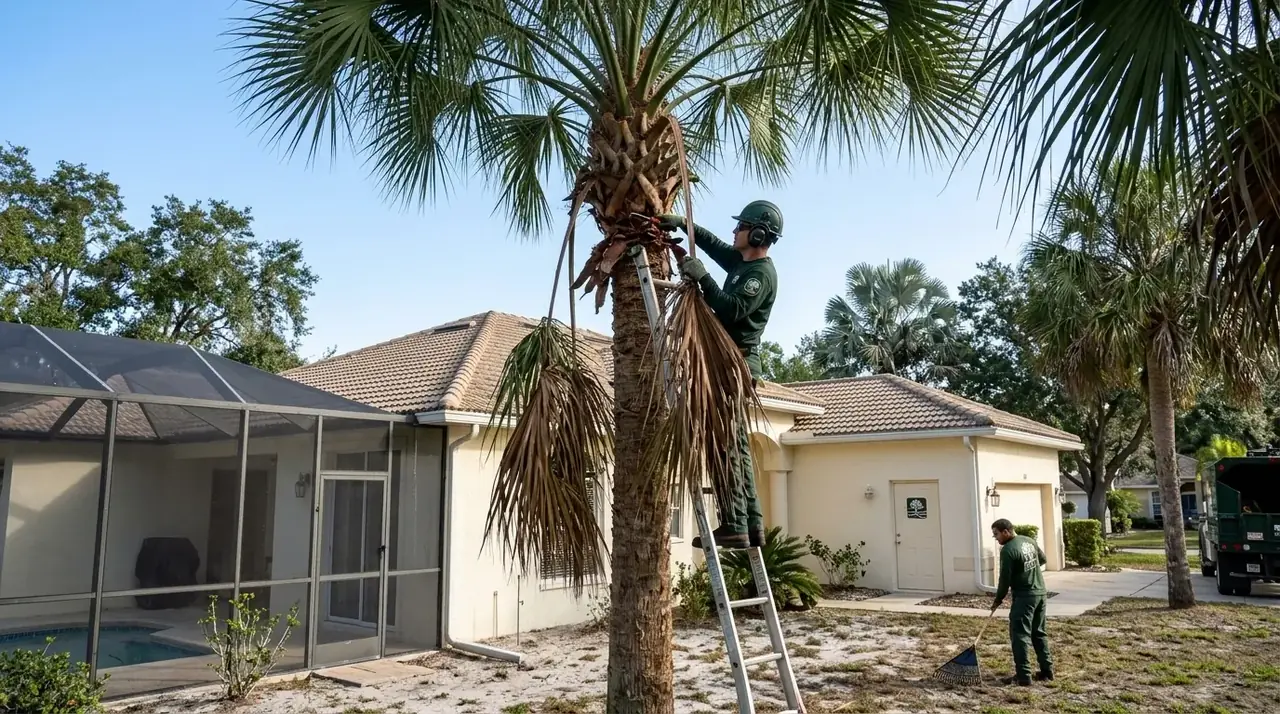
Washingtonia palms (Mexican fan palms) grow very tall, often well past the height of a two-story house, and hold a skirt of dead fronds that can become a fire risk and a home for rats. Trimming usually means a lift or a climber and removing the skirt down to the trunk.
Canary Island date palms are the big, heavy-crowned palms with sharp spines at the base of every frond. They're expensive to replace and vulnerable to Fusarium wilt, a fungal disease that can spread on saw blades from one infected palm to the next. That's one reason we clean tools between palms on every job, and why chainsaws are a bad choice for this species.
Palm Tree Trimming Cost in Clermont, FL
Height and species set most of the price. A short sabal you can reach from a ladder is a quick job, while a 40-foot Washingtonia or a spiny Canary Island date palm takes more time and equipment.
| Job | Typical range | What moves the price |
|---|---|---|
| Short sabal or queen palm, under 15 ft | $85 – $125 | Number of dead fronds, seed stalks |
| Medium palm, 15–30 ft | $125 – $185 | Climbing or lift access, frond volume |
| Tall Washingtonia, skirt removal | $185 – $275 | Height, size of the dead skirt |
| Canary Island date palm | $200 – $275 | Spines, crown size, extra cleanup |
| Multiple palms, one visit | Lower per-palm rate | Setup once for the whole yard |
Palm Diseases Around Lake County: Ganoderma and Lethal Bronzing
Some palm problems can't be trimmed away. Two diseases that worry palm owners across Central Florida are worth learning to recognize on sight.
Ganoderma butt rot is a fungus that rots the lower trunk from the inside. The giveaway is a shelf-like conk, often reddish-brown on top with a white edge, growing on the trunk near the ground. By the time you see one, the inside is usually badly decayed and the palm can snap without warning. There is no cure. The palm should come down, and you shouldn't plant another palm in the same spot because the fungus stays in the soil.
Lethal bronzing, previously called Texas Phoenix palm decline, is caused by a bacterium-like organism spread by a tiny planthopper. Since being found in Florida in 2006, it has spread to more than 30 counties and affects over a dozen palm species, including sabals, Canary Island date palms, and queen palms. Infected palms turn bronze from the oldest fronds up, then the spear leaf dies. Once that happens the palm won't recover. Preventive trunk injections can protect high-value palms nearby, and a diagnostic lab can confirm the disease from a sample.
Palm Trimming Around Pool Cages, Roofs and Power Lines
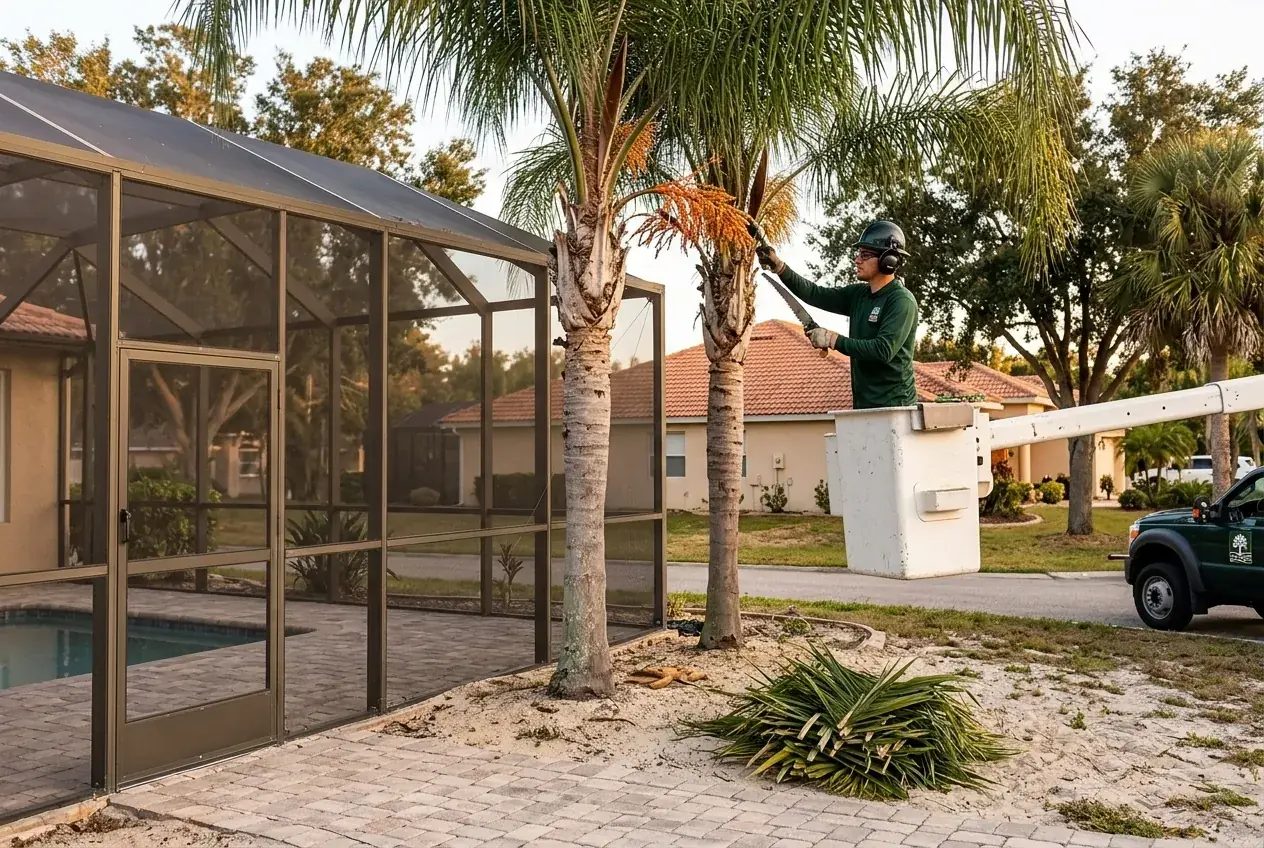
Placement causes more palm headaches than the palms themselves. Queen palms planted a few feet from a screen enclosure drop fruit and old fronds right onto the top panels, and a heavy wet frond falling from 25 feet can punch through screen. We cut those fronds and stalks in pieces and lower them by hand or rope when the cage is directly below. Tall Washingtonias near a roofline get the same treatment so dead fronds don't slide down shingles or crack tile.
Palms that have grown up into the service wire or toward the street lines are a different job. We can trim around the wire to your house carefully, but fronds touching primary lines on the poles need to be handled by your electric utility first. We'll point that out at the estimate rather than on the day of the job.
Timing around storm season is simpler than most people think. You don't need to strip palms before a hurricane. Taking off dead, hanging fronds and heavy seed clusters in late spring is plenty, since those are the parts most likely to blow loose. The green crown is what protects the bud in high wind, so it should go into the season full. Our hurricane prep page covers the rest of the yard.
When to Remove a Palm Instead of Trimming It
A palm that's dead in the bud, has Ganoderma conks, is leaning badly over a house, or is badly over-trimmed and declining may not be worth keeping. Palm removal is usually much quicker and cheaper than removing a hardwood tree of the same height, since there are no heavy limbs to rig. After removal, stump grinding takes out the root ball so the spot can be replanted, although with Ganoderma, choose a non-palm replacement. Our planting guide has suggestions.
Palm Tree Service Near You in South Lake County
We trim palms in every town we serve, from pool-deck queen palms in South Clermont and Horizon West to tall Washingtonias around Winter Garden and wild sabals in Groveland. If you have a mix of palms and oaks, we can combine palm trimming with tree pruning on one visit. Ask for a free quote and tell us how many palms you have.
Questions
Palm Tree Trimming Questions From Clermont Homeowners
Most palms here need one trim a year to remove dead fronds and seed stalks. Fast-growing queen palms may need two, especially if their fruit is dropping on a pool deck. Sabal palms can often go longer since they hold up well on their own. Trimming more often than needed usually means cutting green fronds, which weakens the palm instead of helping it.
A hurricane cut removes all but the newest few fronds, leaving a narrow green tuft at the top. The idea is that fewer fronds catch less wind, but research and UF/IFAS guidance say it doesn't help, and it weakens palms by stripping out nutrients they draw from older fronds. Palms with a full crown actually protect their buds better during storms. We don't do hurricane cuts.
That's usually a nutrient problem, most often potassium or manganese deficiency, which is very common in Clermont's sandy soil. Potassium shortage tends to show on the oldest fronds first as yellow or orange spotting, while manganese shortage affects the newest fronds and makes them weak and frizzled. Don't cut off the yellow fronds, which makes it worse. Use a palm fertilizer with slow-release potassium and manganese.
You don't need to. The leftover frond bases on a sabal trunk don't hurt the palm and will fall off on their own over the years. If you prefer a smooth trunk, we can remove the ones that come off cleanly. Forcing them off too early can scar the living trunk tissue, and those wounds stay visible for the life of the palm.
Look for a hard, shelf-shaped growth on the lower trunk, usually within a few feet of the ground. It can start as a soft white lump and mature into a conk that's reddish-brown on top with a lighter edge. By the time it appears, the trunk is usually badly rotted inside. The palm should be removed, and you shouldn't plant another palm in that same location.
Lethal bronzing has spread across much of Florida since it was first identified in 2006, and UF/IFAS reports it in more than 30 counties. If you see palms around Clermont turning bronze from the bottom up, take it seriously. The UF/IFAS Plant Diagnostic Center can test a sample to confirm. Preventive injections are available for valuable palms, but infected palms can't be cured and should be removed.
Yes, but it takes care. Their fronds have long, sharp spines near the base, so we use protective gear and hand saws or clean pole saws. These palms are vulnerable to Fusarium wilt, which spreads through contaminated tools, so we disinfect blades before starting and avoid chainsaws. They're also heavy-crowned, which means cleanup takes more work than with smaller palms.
Yes. Palm fronds are tough and fibrous and don't break down quickly, so we either run them through the chipper or haul them away. Seed stalks, fruit clusters, and loose boots go with them. Before we leave, the pool deck, lawn, and driveway get raked or blown clean. If you'd rather keep the fronds for your own use, let us know beforehand.
Most palms cost between $85 and $275 to trim. Short sabals and queen palms are at the low end, and tall Washingtonias or spiny Canary Island date palms are at the high end. Several palms trimmed on the same visit usually lowers the per-palm price. We'll give you a written quote for the whole property after counting and looking at each palm.
Remove a palm if its bud has died, if it has Ganoderma conks on the trunk, if it's leaning badly over a structure, or if it shows confirmed lethal bronzing. A palm that has been badly over-trimmed for years and is now visibly thinning at the top may also be in decline. We'll tell you honestly whether trimming and fertilizing can bring it back or if removal makes more sense.
Related
Other tree work we do
Palms looking ragged?
Dead fronds and seed pods off, healthy green left on. Priced per palm.
Mon–Sat 7:00am–7:00pm (24/7 emergency line for storm work) · Licensed & insured