
Service · Clermont, FL
Tree Trimming & Pruning in Clermont, FL
Good pruning makes a tree safer and lets it live longer. We remove deadwood, lift limbs off the roof and pool cage, and shape young oaks so they don't split later, using cuts that heal instead of cuts that rot.
Tree Trimming in Clermont, FL That Helps Trees Last
There's a difference between cutting branches and pruning a tree. Cutting is what happens when someone climbs up and removes whatever is in the way. Pruning starts with a goal for each tree, such as clearing the roof, reducing weight on a long limb, or removing dead wood, and then makes the fewest cuts that reach it. We prune to the ANSI A300 standard, the industry guideline for where and how to cut so a tree can seal over the wound.
In practice that means cutting just outside the branch collar, the slightly swollen ring where a limb meets the trunk, instead of flush against the trunk or leaving a stub. It means removing no more of the living canopy than the tree can handle in one visit. And it means telling you when a job you asked for would harm the tree, then offering a better way to get what you want.
Tree Pruning Services Around Clermont Homes
- Deadwood removal: taking out dead and dying limbs before they fall
- Roof and gutter clearance: lifting branches off shingles and tile, usually back several feet
- Pool-cage clearance: keeping limbs and debris off screened enclosures
- Canopy raising: lifting low limbs over driveways, sidewalks, and lawns
- Structural pruning: training young oaks to a single strong trunk
- Weight reduction: shortening long, heavy limbs that are prone to breaking
- Storm-damage pruning: cleaning up torn and broken branches after high winds
Every job ends with branches chipped and the yard raked. If the wood is clean and you want it, we'll leave a load of chips for your beds.
Pruning Laurel Oaks and Live Oaks in Lake County
Laurel oaks and live oaks look similar from the street, but they need very different care. Laurel oaks grow quickly and shed dead branches constantly as they age. Many of the ones shading Clermont yards were planted or sprouted when the neighborhoods were built, and by now they're carrying a lot of dead wood in the upper canopy. A deadwood pruning every couple of years cuts down on falling limbs. When the trunk itself is rotting, though, pruning only buys time; our laurel oak guide explains the warning signs.
Live oaks are the opposite: slow-growing, strong, and able to live for centuries if they get good structure early. The biggest risk to a young live oak is codominant stems, two trunks of similar size growing from the same point. Left alone, they can split apart in a storm. Structural pruning in the first 10 to 20 years shortens one stem so the other becomes the leader. On mature live oaks with an existing split risk, cabling and bracing can be added to support the union.
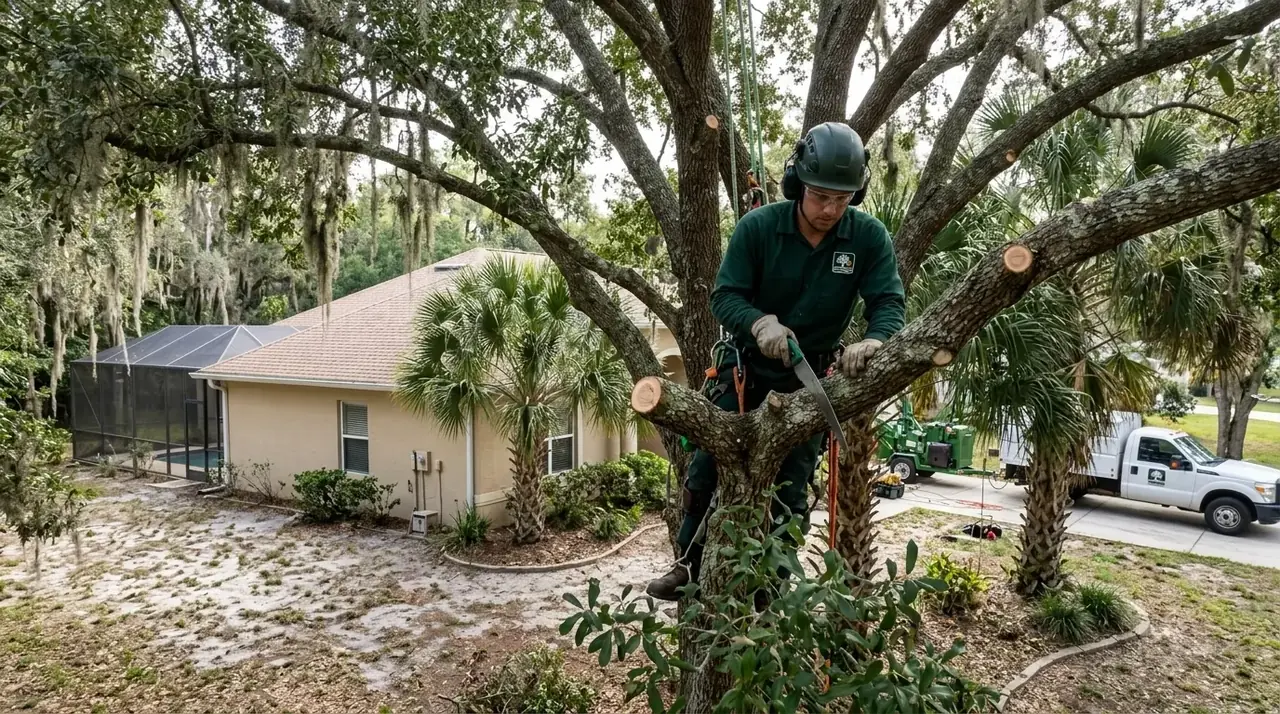
Other trees we prune often around Clermont include southern magnolias, crape myrtles, water oaks, and the turkey oaks and sand-hill oaks on undeveloped ridge lots. Palms have their own rules, covered on our palm tree trimming page.
Tree Trimming Cost in Clermont
Pruning is priced per tree based on size, how much work it needs, and access. Several trees on one visit usually lowers the price per tree, since setup only happens once.
| Job | Typical range | What moves the price |
|---|---|---|
| Small ornamental or young tree | $175 – $325 | Height, how much structural work is needed |
| Medium oak, deadwood and clearance | $325 – $600 | Canopy size, roof and pool-cage proximity |
| Large mature oak, full pruning | $600 – $900 | Climbing time, number of large cuts, rigging |
| Roof clearance only | $200 – $450 | How many limbs touch the house, roof type |
| Young tree structural pruning | $175 – $300 | Number of trees, easy access |
When to Prune Trees in Clermont, FL
Late fall through early spring is the best window for most pruning in Central Florida. Trees are growing slowly, there's less stress from heat, and you'll have the work done before hurricane season starts on June 1. Oaks in particular are best pruned in the cooler months so cuts can close up before the summer growth push. Deadwood and hazard limbs can come out any time of year, and storm-damaged branches should be cleaned up as soon as possible.
Dry spells matter too. Clermont's sandy hilltops hold very little water, and a tree that's already wilting through a rainless April has fewer reserves to respond to fresh pruning wounds. If we're in a long dry stretch, we may suggest watering the root zone deeply for a couple of weeks before major work, or pushing a big reduction back until the rainy season starts to green things up.
When a tree is simply too tall or wide for its spot, crown reduction is the alternative to topping. Instead of chopping limbs to stubs, we shorten each limb back to a smaller side branch that's large enough to take over as the new tip. The tree ends up smaller but still has a natural shape, and the cuts are small enough to close. It takes more climbing time than topping, which is why it costs more, but the tree survives it.
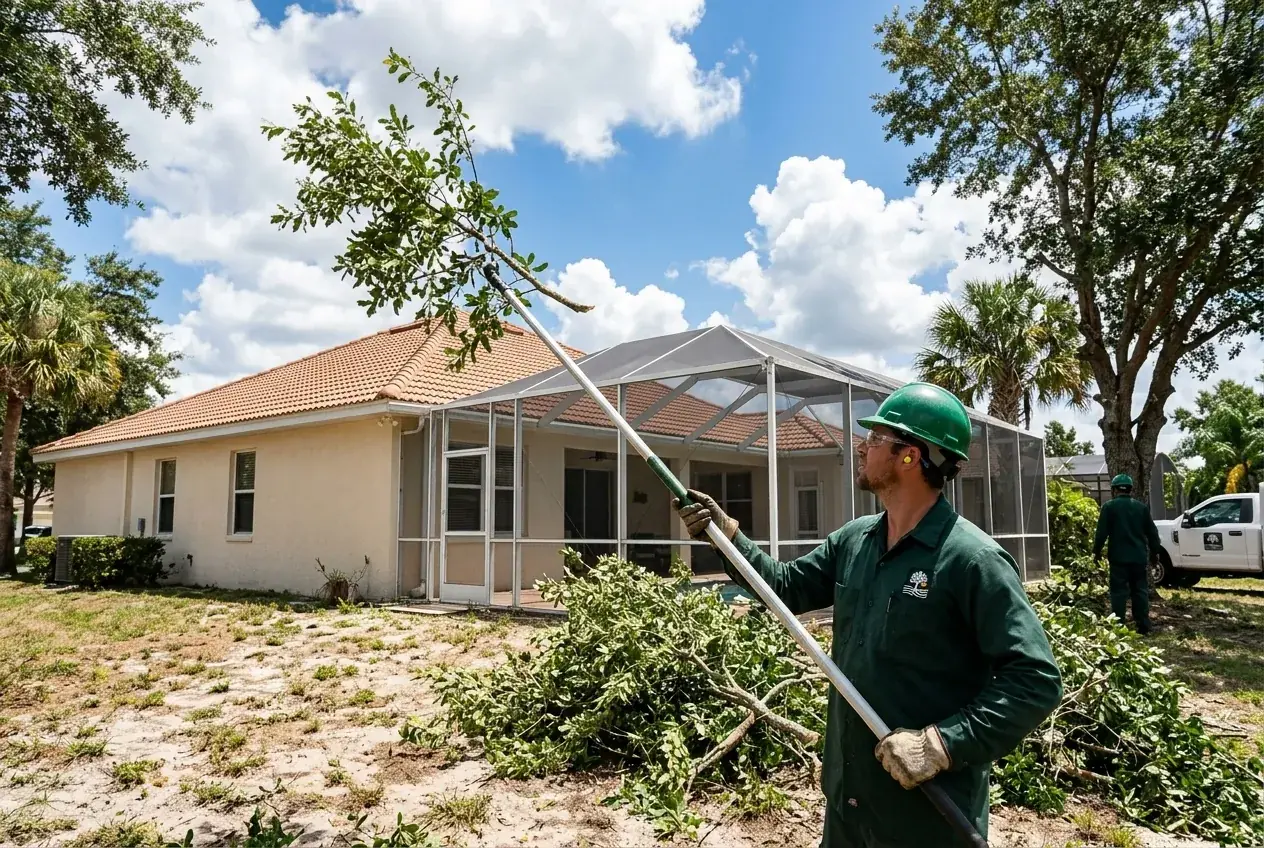
Avoid heavy pruning right before or during hurricane season. A tree that just had a big chunk of its canopy removed can be more prone to wind damage until it adjusts. Light clearance and deadwood work are fine in summer, but plan larger jobs for the cooler months. Our storm prep guide goes into how pruning fits with getting ready for hurricane season.
Tree Pruning for HOAs, Pool Cages and Power Lines
Many neighborhoods in Clermont, Minneola, and Horizon West have HOA rules about how street trees and front-yard trees are maintained, and some require approval before trees are reduced in size. If your HOA has sent a violation notice about clearance over sidewalks or the street, we can raise the canopy to the height they require, usually around 8 feet over sidewalks and more over roads.
Pool cages are the most common reason Clermont homeowners call for trimming. Limbs rubbing against the screen tear it, and leaves and acorns pile up on top. We'll cut back branches so they don't touch or hang over the enclosure, while leaving enough canopy to keep the tree healthy and the pool partly shaded.
Near utility lines, there's a firm limit. We can prune around the service wire to your home with care, but limbs near the main lines on the poles are the utility's responsibility. Duke Energy and SECO Energy both run vegetation management programs, and they should be contacted for branches touching primary lines.
When Trimming Won't Fix the Problem
Pruning can't save a tree with a rotting trunk, a heavy lean in loose sand, or roots cut off by a new driveway or pool. If we see those problems, we'll tell you. Sometimes the best plan is removing the tree and planting something better suited to the space. Trees protected by local rules may need a permit even for major pruning in some places, which we'll check when we come out. Book a free estimate and we'll walk through every tree on your property.
Tree Trimming Service in Clermont and Surrounding Towns
Our pruning crews work every week in Windermere, Gotha, Montverde, and Downtown Clermont, along with the rest of South Lake County. The big old oaks around Windermere and Gotha get a lot of structural and clearance work, while newer Clermont neighborhoods tend to need roof, pool-cage, and young-tree pruning. Most jobs are scheduled within two weeks.
Questions
Tree Trimming & Pruning Questions From Clermont Homeowners
Most mature oaks benefit from pruning every three to five years. Laurel oaks, which drop a lot of dead wood as they age, often need attention every two or three years. Young oaks do best with light structural pruning every couple of years while they're developing. Trees that hang over a roof, pool cage, or driveway may need more frequent clearance work, depending on how fast they grow back.
ANSI A300 is the national standard for tree care practices in the United States. For pruning, it covers where to make cuts, how much live canopy to remove, and which practices to avoid, like topping and flush cuts. Pruning to this standard means the tree can seal its wounds properly and resist decay. It's the reason we cut just outside the branch collar instead of right against the trunk.
Topping removes large sections of the canopy by cutting back to stubs. The tree responds by sprouting clusters of fast, weakly attached shoots that break easily in wind. The big wounds don't close and often rot, which can hollow out the trunk over time. Topped trees can also become more dangerous than they were before. If a tree is too large for its spot, crown reduction or removal is usually the better choice.
Late fall through early spring is ideal for most trees here. Growth slows in the cooler months, which lets pruning cuts close before the summer growth push, and you'll be done well before hurricane season starts. Dead or dangerous branches can be removed any time. Avoid major pruning in early summer, when heat stress and storm season make it harder on the tree.
We usually aim for several feet of clearance between branches and the roof, enough that limbs won't scrape shingles or tiles when they move in wind and leaves won't pile up in gutters. Exact distance depends on the tree's species, growth rate, and structure. We remove branches back to proper pruning points rather than cutting them all at one distance, which would leave stubs.
We can prune around the service wire that runs from the pole to your house, carefully and with the right setup. Branches near the main distribution lines on the poles are a different matter and should be handled by the utility or its line-clearance contractors. Contact Duke Energy or SECO Energy, depending on who serves your address, and they'll schedule their crews.
Some do, especially for major pruning or reducing a tree's height, and some require specific clearance over sidewalks and streets. Routine deadwood removal and roof clearance usually don't need approval, but check your community's rules to be sure. If your HOA has sent a notice, send us a copy and we'll trim to what it asks for.
Good pruning helps. Removing dead branches, shortening overly long limbs, and fixing weak structure in young trees all lower the chance of breakage. But removing too much canopy, or thinning only the inside of the tree, can make it worse. The goal is a balanced crown that lets wind pass through without stripping the interior branches. We'll explain what we're removing and why before we start.
For most mature trees, we remove no more than about a quarter of the living canopy in one season, and often far less. Older trees tolerate heavy cuts poorly, and losing too many leaves at once stresses the tree and can trigger decay or a flush of weak sprouts. Dead branches don't count toward that limit, since they aren't feeding the tree.
Routine pruning generally doesn't require a permit, but rules differ between the City of Clermont, other towns, and unincorporated Lake County, and some protect heritage trees or specific species from heavy cutting. We check the rules for your address during the estimate. If anything requires approval, we'll explain the process. Our permit guide covers the basics.
Related
Other tree work we do
Book a trim before storm season
Deadwood out, roof and cage cleared, a written price before we climb.
Mon–Sat 7:00am–7:00pm (24/7 emergency line for storm work) · Licensed & insured