
Service · Clermont, FL
Tree Cabling & Bracing in Clermont, FL
A big oak with two trunks pulling apart doesn't always have to come down. Steel cables and through-bolted rods can limit how far the stems move in wind, which buys a sound tree years of extra life.
Tree Cabling in Clermont for Oaks Worth Saving
Some of the best trees in South Lake County have a weak point built right into them. Two trunks grow up side by side from the same spot, each getting thicker every year, until the bark between them gets squeezed into the joint instead of forming solid wood. On a calm day, nothing seems wrong. In a tropical storm, each trunk catches wind separately and the joint flexes back and forth until it cracks.
Cabling and bracing is how arborists support that kind of weak union without cutting the tree down. A cable installed high in the canopy limits how far the stems can spread apart. A brace rod bolted through the trunk lower down holds a crack or split together. Done on the right tree, it can extend the tree's life by years. Done on the wrong tree, it just delays an inevitable failure, and we'll tell you which one you have.
Cabling and Bracing Services Clermont Homeowners Ask About
- Static cabling: high-strength steel cable anchored with through-bolts or lag hardware, about two-thirds of the way from the union to the top of the stems
- Dynamic cabling: synthetic rope systems that allow some natural movement while catching sudden loads
- Brace rods: threaded steel rods through the trunk below a weak union or across an existing crack
- Weight-reduction pruning: shortening the heaviest limbs so the support system carries less load
- Follow-up inspections: checking hardware, cable tension, and new wood growth around the bolts
Most cabling jobs are paired with pruning. Reducing the end weight of a long, heavy stem cuts the stress on the union more than any cable can alone. That's why our quotes often include both, and why cabling usually goes along with tree trimming and pruning on the same visit.
Co-Dominant Stems and Included Bark: What We Look For
A strong branch union looks like a U, with a raised ridge of bark where the two parts meet. A weak one looks like a narrow V, often with a seam of bark pushed down into the crotch. That trapped tissue is called included bark, and it acts like a wedge, preventing the two stems from fusing with solid wood. Live oaks, laurel oaks, water oaks, and southern magnolias all develop this problem around Clermont, especially when young trees weren't pruned to a single leader.
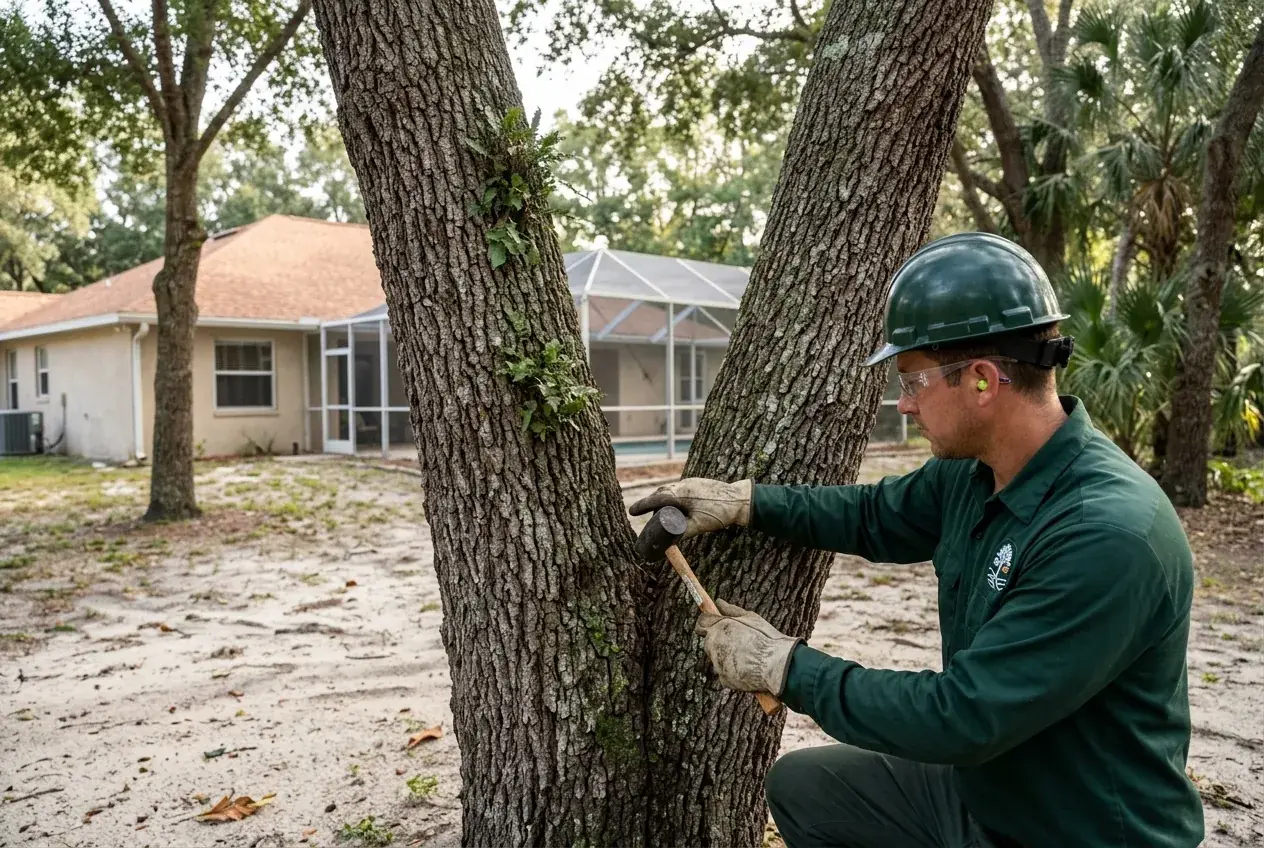
When we inspect a union, we look at the angle, check for cracks running down from the joint, tap the wood to listen for hollow spots, and look for oozing, fungal growth, or swelling. We also look at what the tree would hit if one stem failed. A split oak over an open field is a lower priority than one over a bedroom or a pool cage.
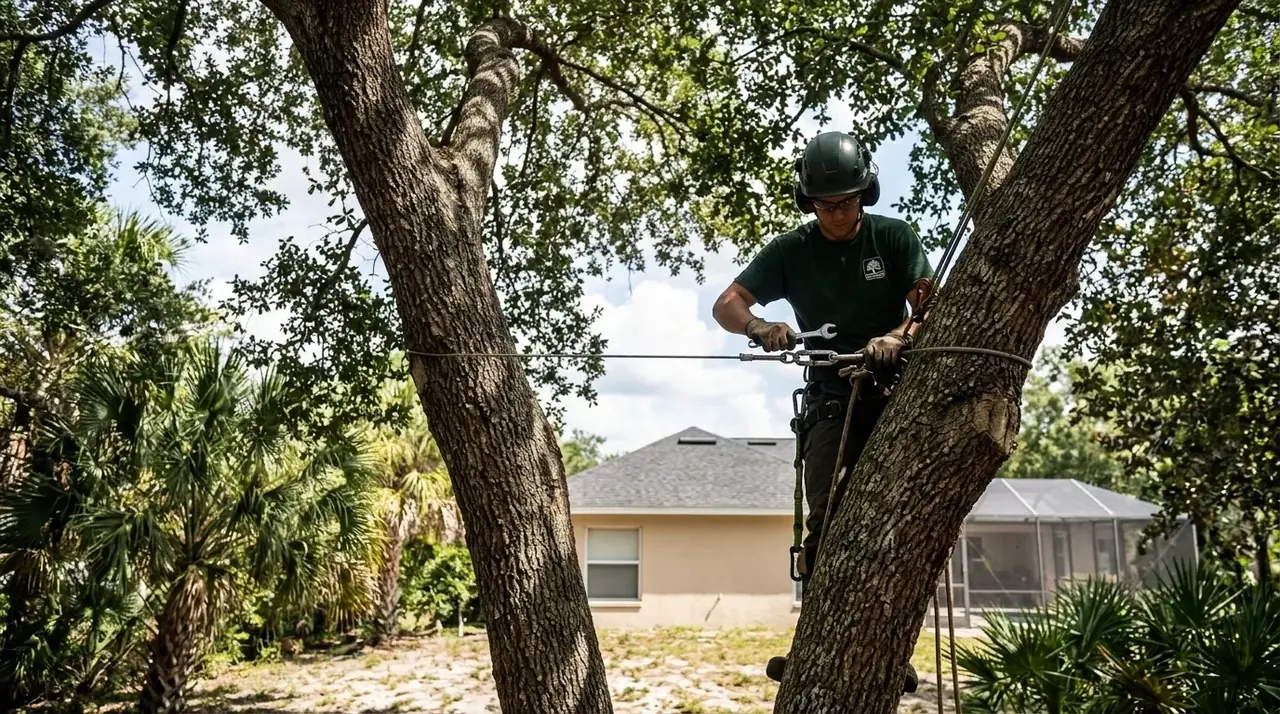
After Hurricane Ian and again after Milton, a common kind of oak damage across Central Florida wasn't whole trees tipping over. It was one half of a two-trunk oak tearing away and landing on a roof, a fence, or a lanai while the other half stayed standing. Those splits almost always happened at a tight V-shaped union that had been building toward failure for years. That's exactly the kind of tree cabling is designed for, provided the wood is still sound.
The cheapest fix of all happens years earlier. A young oak with two competing leaders can be corrected with a few pruning cuts that cost far less than any hardware. If you planted trees when your home was built in one of the newer Clermont or Minneola subdivisions, now is a good time to have their structure checked before the problem gets locked in.
When Tree Bracing Is Pointless
Cables and rods hold sound wood together. They can't make rotten wood strong. If a tree has a hollow trunk, large areas of decay at the union, mushrooms or conks growing near the base, or a trunk that's already split deep, support hardware won't prevent failure. The bolts need solid wood to grip, and decay keeps spreading around them.
Laurel oaks are a common example. Many of the older laurel oaks in Clermont neighborhoods are already decaying by the time a split shows up, and cabling a hollow laurel oak is usually money spent on a tree that's going to fail anyway. Our article on why laurel oaks fail covers what's going on inside those trees. For trees in that condition, tree removal is the safer choice, and we'll give you both prices so you can compare.
Tree Cabling Cost in Clermont, FL
Price depends on how high the hardware goes, how many cables or rods the tree needs, and whether pruning is part of the job.
| Job | Typical range | What moves the price |
|---|---|---|
| Single cable, medium tree | $350 – $550 | Climbing height, stem diameter |
| Multiple cables, large oak | $550 – $900 | Number of stems tied together, hardware size |
| Brace rod through a split or weak union | $400 – $750 | Trunk thickness, number of rods |
| Cabling plus weight-reduction pruning | $700 – $1,200 | Size of the canopy, number of reduction cuts |
| Follow-up hardware inspection | Quoted with other work | Often combined with routine pruning visits |
Tree Support on Clermont's Hills and Sandy Ground
Cabling works on the upper tree. It does nothing for the roots. On the Clermont hills, where pale sand drains fast and roots run wide and shallow, a large oak can be structurally fine above ground and still at risk of tipping over when the soil gets soaked. A tree on a slope with a lean toward the house needs a root-zone check before anyone talks about cabling.
We look for raised soil on the side opposite a lean, exposed roots cut by driveways or pool construction, and erosion on the downhill side. If the root system is the weak link, adding hardware to the canopy won't help. Our article on trees on Clermont hills explains what slope and sandy soil do to tree stability.
Inspection Intervals and What to Expect
Support hardware needs regular checks. We recommend looking at cabled trees every one to two years, and after any storm with strong winds. During an inspection, we check that cables are still under the right tension, look for fraying or corrosion, and see how the tree is growing around the bolts. As a tree grows, hardware may need to be adjusted or moved higher to stay effective.
- Assessment: during the free estimate, we look at the union, the wood, and the roots
- Install: most single-tree cabling jobs take a few hours, including any reduction pruning
- First check: one to two years after installation, or sooner after a major storm
- Long term: regular inspections with routine pruning visits, every one to two years
If a cabled tree starts to show new decay, deep cracks below the hardware, or significant dieback, it's time to reconsider. Hardware extends life; it doesn't stop aging. At that point we'll talk through removal options, and if the tree comes out, stump grinding can clear the spot for a better-structured replacement.
Tree Cabling Service in Clermont and Nearby
We install and inspect cabling across the area, including old live oaks in Windermere and Oakland, lakefront trees in Howey-in-the-Hills, and hillside yards in Minneola. If you have a big tree with two trunks and you're not sure if it's at risk, schedule a free look and we'll tell you honestly whether it's a candidate.
Questions
Tree Cabling & Bracing Questions From Clermont Homeowners
Cabling connects two or more stems high in the canopy with a steel cable or synthetic rope so they can't spread apart too far in wind. That takes stress off the union where the stems meet, which is often the weakest point on the tree. It doesn't stop the tree from moving entirely. It limits the extreme movement that causes splits during storms.
Look where the main trunk divides. A strong union usually has a U shape with a ridge of raised bark. A weak one forms a tight V, sometimes with bark folded down into the crotch, called included bark. Cracks running down from the union, oozing sap, or a seam that looks like it's opening are warning signs. We can assess it during a free estimate.
Sometimes. If the wood around the crack is sound, a brace rod bolted through the trunk can hold the two sides together and keep the crack from spreading. If the crack is deep, runs well down the trunk, or shows signs of decay inside, the tree is usually too weak to rely on hardware. In those cases removal is the safer option, and we'll explain why.
Installing hardware does create small wounds where bolts go through, but a healthy tree seals around them over time. The tradeoff is usually worth it for a tree with a serious split risk. Modern methods also include non-invasive synthetic cabling systems that wrap around stems instead of drilling. We'll choose the method that fits the tree's size and the load the system needs to handle.
Steel cable systems can last many years when properly installed and inspected. The tree, however, keeps growing, so hardware may need to be adjusted, re-tensioned, or moved higher every so often to stay effective. Synthetic systems often need replacement sooner. Regular checks every one to two years keep the support working as the tree changes.
Usually not, unless it's fairly young and the wood is sound. Older laurel oaks in Central Florida are often decaying inside by the time a weak union becomes a concern, and hardware can't hold rotten wood together. We'll check for hollowness and decay first. If the tree is sound, cabling can be reasonable. If it's not, you're better off planning a removal.
In most cases, yes. A single cable on a medium tree often costs less than half what removing that tree would cost, especially if the tree is large and close to a house. But cabling comes with ongoing inspection costs and doesn't last forever. For a sound, valuable tree, it's usually money well spent. For a declining tree, it may only push the removal down the road.
Cabling generally doesn't need approval since the tree stays in place, and many communities encourage saving mature trees when possible. If your HOA has rules about tree work, it's still worth checking. Rules vary between Clermont neighborhoods. Cabling can also be a way to keep a protected tree that might otherwise need a permit to remove.
If the split is fresh, relatively small, and the wood is healthy, bracing may hold it. We'd also prune to reduce weight on the damaged stem. If a large section has torn away or the trunk is split deeply, the tree has usually lost too much structure. After a storm, we'll check carefully before recommending any hardware.
Every one to two years is the standard, plus a check after any major wind event like a hurricane or severe thunderstorm. We look at cable tension, wear on the hardware, how the bark is growing around anchors, and whether new cracks or decay have shown up. It's easy to fold inspections into regular pruning visits so you aren't paying for extra trips.
Related
Other tree work we do
Worth saving? Let us look
We will tell you honestly whether cabling makes sense or the tree should come down.
Mon–Sat 7:00am–7:00pm (24/7 emergency line for storm work) · Licensed & insured