
Service · Clermont, FL
Tree Removal in Clermont, FL
Dead laurel oak over the roof, a pine leaning toward the pool cage, or a tree that just outgrew the yard: we take it down in sections, haul every piece away, and quote the job in writing before a saw starts.
Clermont Tree Removal Without the Guesswork
Most calls we get for a removal start the same way: a homeowner has watched a tree get worse for a year or two and finally decided it can't stay. Sometimes that's a laurel oak dropping dead limbs on the driveway. Sometimes it's a slash pine that went brown from the top down after a dry spring. And sometimes the tree is perfectly healthy but it's lifting the pool deck or sitting where the new lanai is going. All of those are good reasons, and we handle each one the same careful way.
We walk the property with you, look at what the tree is leaning over, check where the power service drop runs, and figure out where the pieces can safely land. Then you get a flat written price. That number covers the cutting, the rigging, the chipping, and the haul-off. If the stump needs to come out too, we price stump grinding as a separate line so you can decide.
- A free on-site look at the tree, the drop zone, and anything it could hit
- A flat written quote before any work begins, with nothing added later for brush
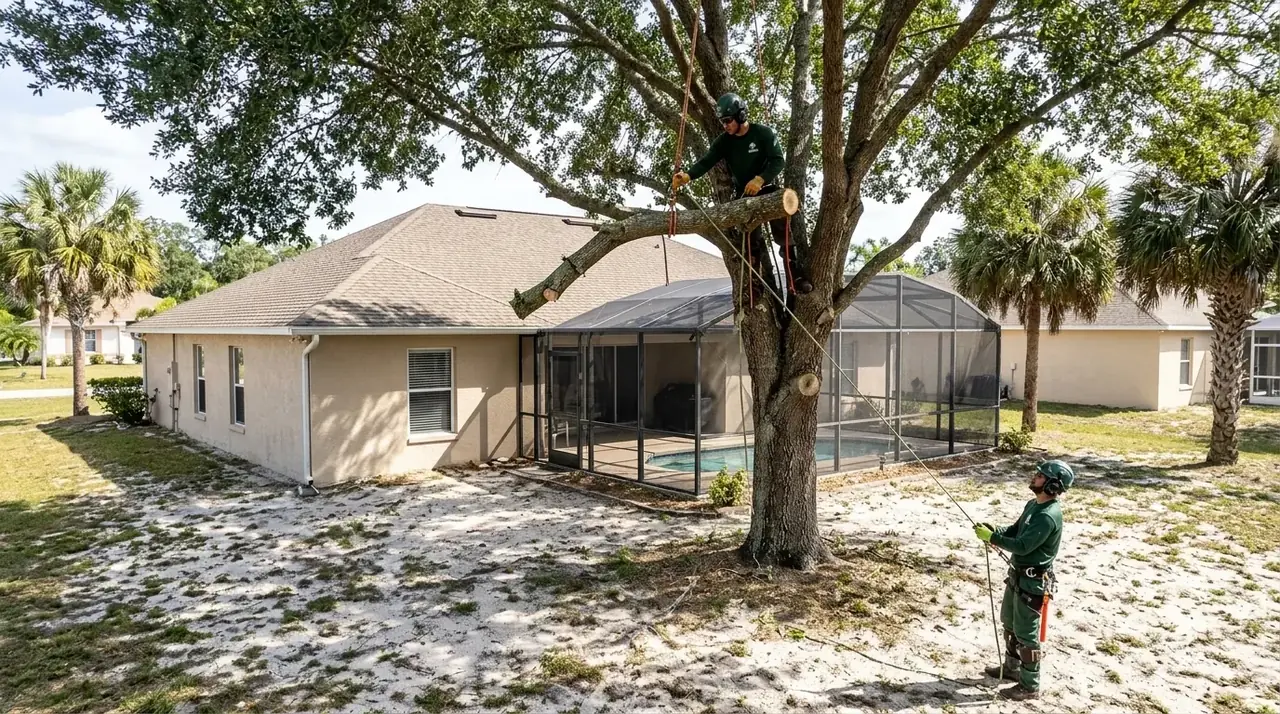
- Sectional takedown with ropes and lowering devices when the tree is near a roof, fence, or pool enclosure
- Crane-assisted removal when a climber can't safely reach or lower the wood
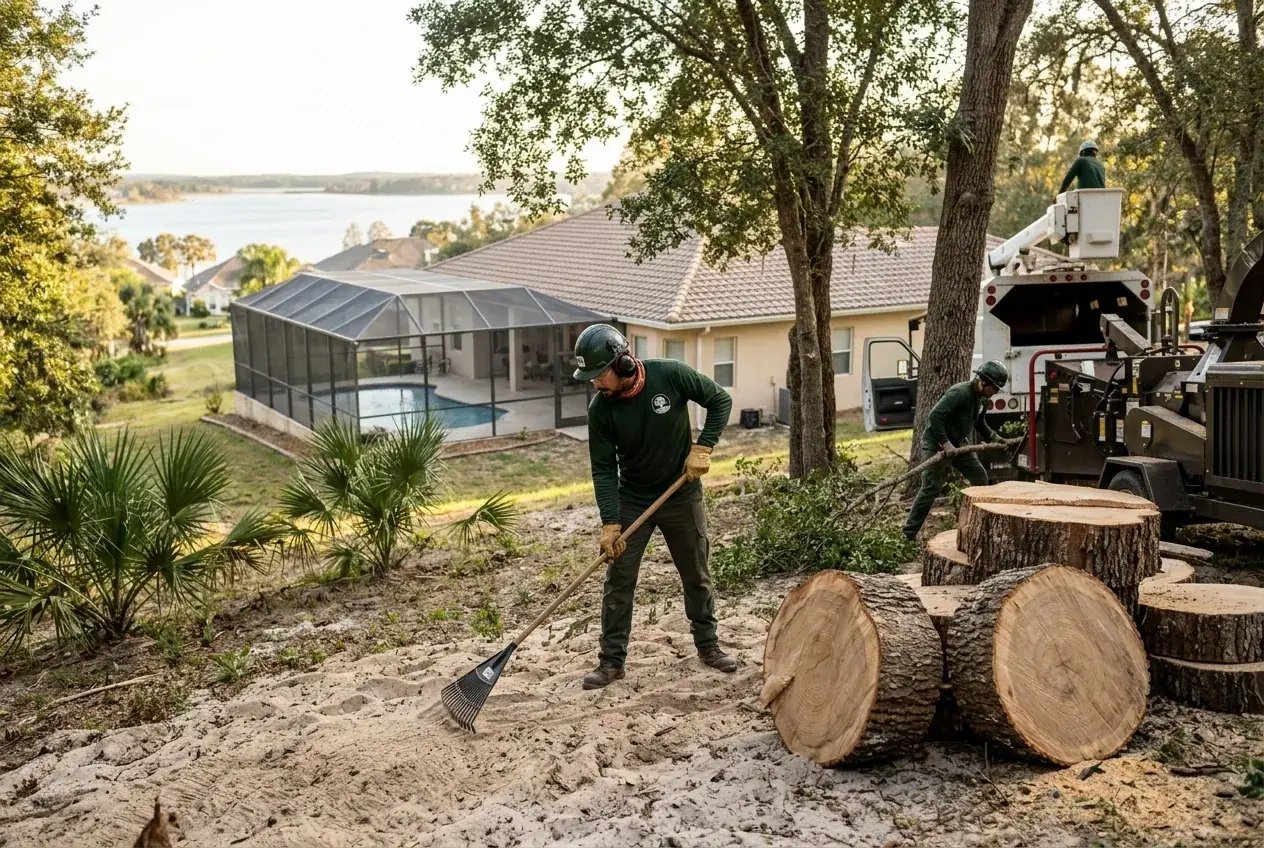
- Chipping of branches and loading of all trunk wood on the same visit
- Raking and blowing the work area so the lawn and driveway are left clean
- Optional stump grinding, quoted separately, often done the same day
Tree Removal Cost in Clermont, FL
Height drives most of the price, but it isn't the only factor. A 45-foot oak standing alone in an open front yard can cost less than a 30-foot tree wedged between a two-story house and a pool cage, because the second one has to come down in small pieces on ropes. Here's how typical jobs break out around South Lake County. Full numbers and examples are in our guide to what tree removal costs in Clermont.
| Job | Typical range | What moves the price |
|---|---|---|
| Small tree under 30 ft | $350 – $850 | Open access vs. a fenced backyard, how much brush is attached |
| Medium tree 30–60 ft | $850 – $1,800 | Climbing and rigging over structures, trunk diameter |
| Large or mature tree 60 ft+ | $1,800 – $3,500+ | Wood volume, spread of the canopy, multiple leaders |
| Crane-assisted removal | Add $600 – $1,800 | Crane size, setup space, how far the boom must reach |
| Stump grinding (optional) | $95 – $450 per stump | Stump width, surface roots, gate access for the grinder |
Removing Trees on Clermont's Hills, Lakes and Tight Lots
Clermont sits on the northern end of the Lake Wales Ridge, and that geography shapes how trees grow and fail here. The soil is deep, pale sand that drains fast. Roots spread wide and shallow looking for water, so a tree on a slope can hold for decades and then tip over in one soaked afternoon. On hillside lots off Hancock Road or near Sugarloaf Mountain, we plan the drop so wood rolls toward the flat side of the yard, not downhill toward the neighbor's fence.
Lakefront yards bring their own issues. Ground near Lake Minneola and the rest of the Clermont Chain of Lakes can stay soft for weeks after summer storms, which limits where a lift or crane can sit without rutting the lawn. We'll use ground mats, or switch to climbing and lowering if heavy equipment would tear up the shoreline.
Power lines are the other big variable. If limbs are tangled in the service wire running to your house, we can usually work around it carefully. If a tree touches the main distribution lines along the street, the utility has to be involved first, which is Duke Energy or SECO Energy for most South Lake addresses. We'll tell you which one at the estimate and help you make that call, since nobody without utility-line clearance training should be cutting near energized primary lines.
Laurel oaks top the list. They grow fast, look full, and often rot from the inside by the time they're 50 or 60 years old. We explain the warning signs in why laurel oaks fail in Central Florida. After that come pines hit by lightning or bark beetles, camphor trees (an invasive species that crowds out natives), and old water oaks with split trunks. For pines specifically, see our pine tree removal page, and for dead backyard orange and grapefruit trees, citrus tree removal is usually a much cheaper job.
Do You Need a Permit for Tree Removal in Clermont?
It depends on where you live and what kind of tree it is. The City of Clermont, Minneola, Groveland, Lake County, and the Orange County towns to the east all handle tree rules differently, and some protect certain species or trunk sizes. Florida Statute 163.045 adds a wrinkle: on residential property, a local government can't require a permit, fee, or replacement planting for a tree that an ISA certified arborist or a Florida licensed landscape architect documents as a danger to people or property. That documentation still matters, so keep it.
We check the rules for your address on every estimate and tell you what applies before we schedule. Our post on tree permits in Clermont walks through the basics, but confirm anything unusual with your city or the county directly.
When Tree Removal Isn't the Right Call
We'd rather tell you a tree can stay than take your money for a removal you'll regret. A live oak with one dead limb usually needs pruning, not a chainsaw at the base. A healthy oak with two trunks splitting apart can sometimes be held together with cabling and bracing for a fraction of the cost. And a tree that just needs clearance from the roof is a job for tree trimming and pruning.
On the other hand, we will recommend removal when we see a hollow trunk with less than a third of solid wood, mushrooms growing at the root flare, a sudden new lean, cracked soil on one side of the base, or large dead sections in the crown. Those trees don't get better, and they tend to fail during the exact storms you most want them standing through.
How a Typical Tree Removal Day Goes
For a medium oak in a fenced backyard, a typical day looks like this. We arrive around 7am, lay plywood or mats over the lawn path, and talk through the plan with you one more time. A climber ties in and removes limbs from the top down, lowering each one on a rope so nothing hits the house or the screen. The ground crew feeds the chipper as they go. Once the canopy is gone, the trunk comes down in sections short enough to roll. Cleanup takes the last hour or so.
- Estimate: usually within a day or two of your call
- Scheduling: most standard removals are booked within one to two weeks
- On site: a few hours for a small tree, a full day for a large one, two days for big multi-tree jobs
- Emergencies: trees on a roof or blocking a driveway go to our emergency tree removal crew instead of the regular schedule
Tree Removal Near You in South Lake and West Orange
We're based in Clermont and work across the surrounding towns every week. That includes lakefront homes around Downtown Clermont and Lake Minneola, the rolling lots of Minneola, older properties in Groveland, and newer neighborhoods in Horizon West. If your tree is somewhere in between, it's almost certainly in range. Request a free estimate and we'll come out and give you a straight answer on whether it needs to go.
Questions
Tree Removal Questions From Clermont Homeowners
Most removals in Clermont land between $350 and $3,500, with small trees at the low end and large mature oaks or pines at the high end. The biggest price factors are height, how close the tree is to the house or pool cage, and whether a crane is needed. Crane setups add roughly $600 to $1,800. We give you a flat written price after looking at the tree in person, and that price includes cleanup and haul-off.
Not automatically. We cut the trunk low to the ground as part of every removal, but grinding the stump below grade is a separate line on the quote, usually $95 to $450 depending on size. Some people want it ground right away so they can sod over it. Others leave it for a few months or plan to build over the area. Listing it separately lets you choose without paying for something you don't need.
Yes, and it's one of the most common jobs we do in Clermont. Screened pool cages are easy to dent and expensive to fix, so we never drop pieces near them. A climber removes the tree from the top down, and each limb is tied off and lowered on a rope to the ground crew. On very tight lots we may bring in a crane to lift sections up and over the house instead.
No. Plenty of customers are at work when we do the job. We do need gate access, a clear path for equipment, and a way to reach you by phone if something comes up. We'll confirm the plan before the day, and we'll text or call when we're finished. Most people like to walk the yard afterward to make sure the cleanup meets their standard.
A small tree in an open yard can be down and cleaned up in two or three hours. A medium oak in a fenced backyard takes most of a day. Large trees with heavy rigging, or a crane job with several trees, can stretch into a second day. The estimate will tell you how long we expect to be there so you can plan around it.
Sandy Clermont lawns hold up better than you'd think, but heavy equipment can still leave ruts, especially near the lakes after rain. We lay down plywood or ground mats along the path to the tree and keep the chipper on the driveway or street when we can. If the ground is too soft, we'll wait a day or change methods rather than tear up your yard.
Branches go through the chipper on site, and the trunk wood gets loaded and hauled away with everything else. If you want to keep some rounds for firewood or a fire pit, just tell us before we start and we'll cut them to a size you can move and stack them where you want. Some customers also ask to keep a load of chips for garden beds.
Many Clermont and Minneola neighborhoods require an architectural review request before a tree comes down, and some require a replacement tree. We can put the tree's condition, size, and the reason for removal in writing on our estimate, which usually covers what the HOA form asks for. You submit the request, and we schedule the work once you have approval.
If a tree is dead, hollow, leaning toward the house, or dropping large limbs, getting it down before June is smart. Storm season fills our schedule fast, and emergency rates after a storm run 25 to 50 percent higher. A healthy tree with good structure usually doesn't need to go. Our hurricane prep guide covers what to check first.
You can, but not right on top of the old stump. Even after grinding, buried roots and wood chips take time to break down. It's better to shift the new tree a few feet over, or haul out the grindings and backfill with fresh soil. Pick something suited to sandy ridge soil and the space you have. We list good choices in trees to plant after a removal.
Related
Other tree work we do
Get a price on that tree
One visit, one written number, cleanup included. Call or text a photo.
Mon–Sat 7:00am–7:00pm (24/7 emergency line for storm work) · Licensed & insured