
Hurricane Tree Prep in Lake County: Why It Matters Inland
When Hurricane Milton crossed the state in October 2024, the National Weather Service office in Melbourne reported wind gusts of roughly 55 to 75 mph in Lake County, rainfall of 6 to 11 inches, and numerous downed trees and power lines. A county damage assessment counted 285 affected structures. Two years earlier, Hurricane Ian brought days of rain to Central Florida, and Lake County's worst flooding came along the St. Johns River near Astor, where the river reached a record crest.
Neither storm needed to be a direct hit to bring trees down around Clermont. Long hours of tropical-storm-force gusts on top of soaked ground are enough to topple weak trees and snap decayed limbs. The good news is that most of those failures give warning signs months in advance.
Lake County Hurricane Tree Checklist: What to Look At First
Start with the trees that can reach your house, your driveway, your pool enclosure or a power line. A tree that can only fall into an empty back lot is a lower priority. For each tree within striking distance, look for these:
- Dead branches, especially large ones in the upper canopy.
- Cracks, cavities or conks on the trunk or at the base.
- Two equal trunks forming a tight V with bark pinched between them.
- A new lean, or soil cracking and lifting on one side of the trunk.
- Limbs rubbing the roof or hanging over the service drop to your house.
- Species known to fail in wind, such as older laurel oaks, water oaks and sand pines.
UF/IFAS hurricane research places laurel oak, water oak and sand pine in the lowest wind-resistance group for the Southeastern Coastal Plain. Our post on why laurel oaks fail in Central Florida explains why so many of them break.
Storm Pruning Around Clermont: What Helps
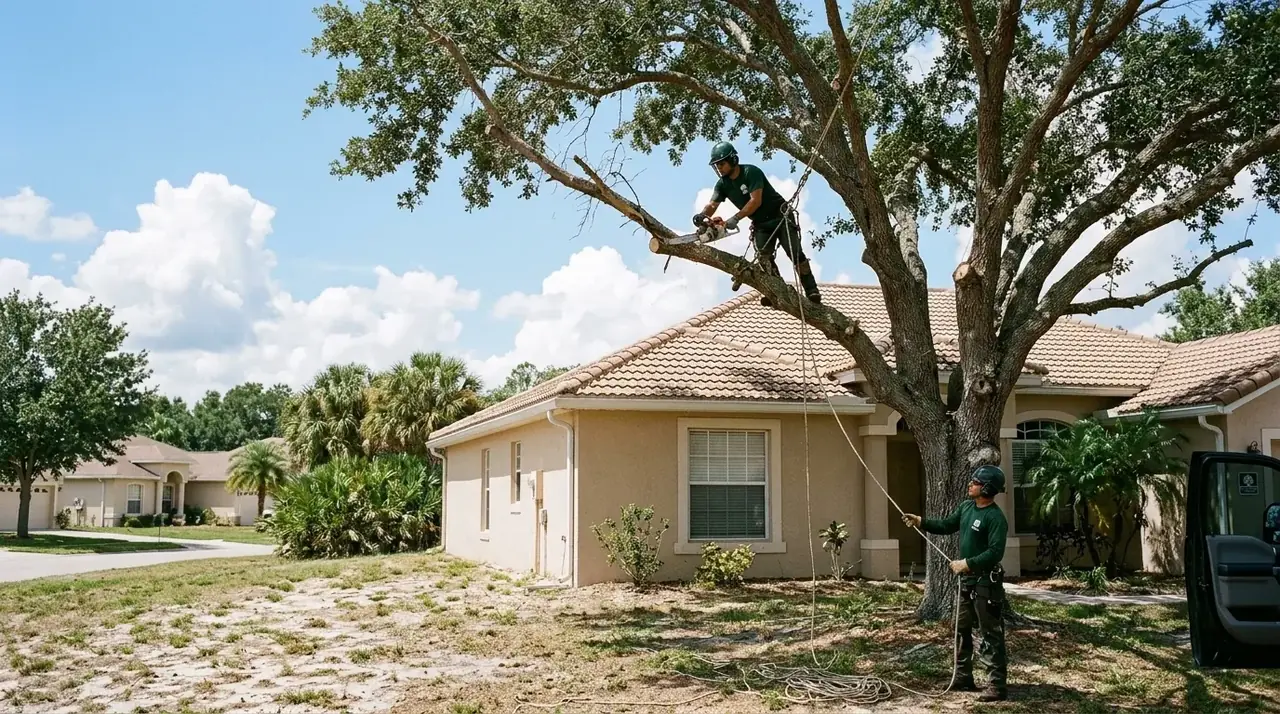
Good pruning measurably improves survival. In a UF/IFAS study of trees after Hurricane Andrew, properly pruned trees, meaning not topped and with open, well-distributed crowns, survived at 73 percent compared with 47 percent for unpruned trees. The goal is not to strip the tree. It is to remove weak and dead wood and reduce the long, heavy limbs most likely to fail.
- Remove dead, broken and hanging branches throughout the crown.
- Shorten long limbs that extend far over a roof, reducing weight at the tips.
- Correct weak forks on younger trees with structural pruning while the cuts are still small.
- Clear limbs back from the roof line so wind does not grind them into shingles.
- Consider cabling for a valuable tree with a weak union and otherwise sound wood.
The best time to do this is before the season gets busy, not the week a storm shows up in the forecast. Our tree trimming and pruning crews book up fast once the cone reaches Florida.
Hurricane Tree Mistakes Lake County Homeowners Should Avoid
Topping or lion-tailing
Cutting a tree's top off, or stripping all the inner branches so foliage only remains at the ends, makes it weaker in wind, not stronger. Topping creates large wounds that decay, and the new sprouts that follow attach poorly and break easily in the next storm. UF/IFAS lists topping and removing large branches among the poor pruning practices that make trees more susceptible to wind failure.
Hurricane cuts on palms
Stripping a palm down to a few fronds at the top, sometimes called a hurricane cut, harms the palm. UF/IFAS extension guidance says it weakens palms and leaves the bud more exposed to wind. Remove only fully brown or dead fronds and any loose fruit stalks, and leave green fronds alone. Our palm tree trimming follows that approach.
Last-minute cutting
Trimming the day before landfall leaves piles of loose branches at the curb that can become projectiles, and collection services are usually suspended before a storm. If you missed the window, it is often better to leave a healthy tree alone and deal with it afterward.
After the Storm: Clermont Storm Damage Cleanup Steps
Stay safe first
Treat every downed wire as live and stay well away from it. Report it to your electric provider. Do not climb onto a roof to clear limbs or start a chainsaw on a tree that is bent or pinned under tension. Spring-loaded wood can kick with enough force to cause serious injury.
Photograph before anything is moved
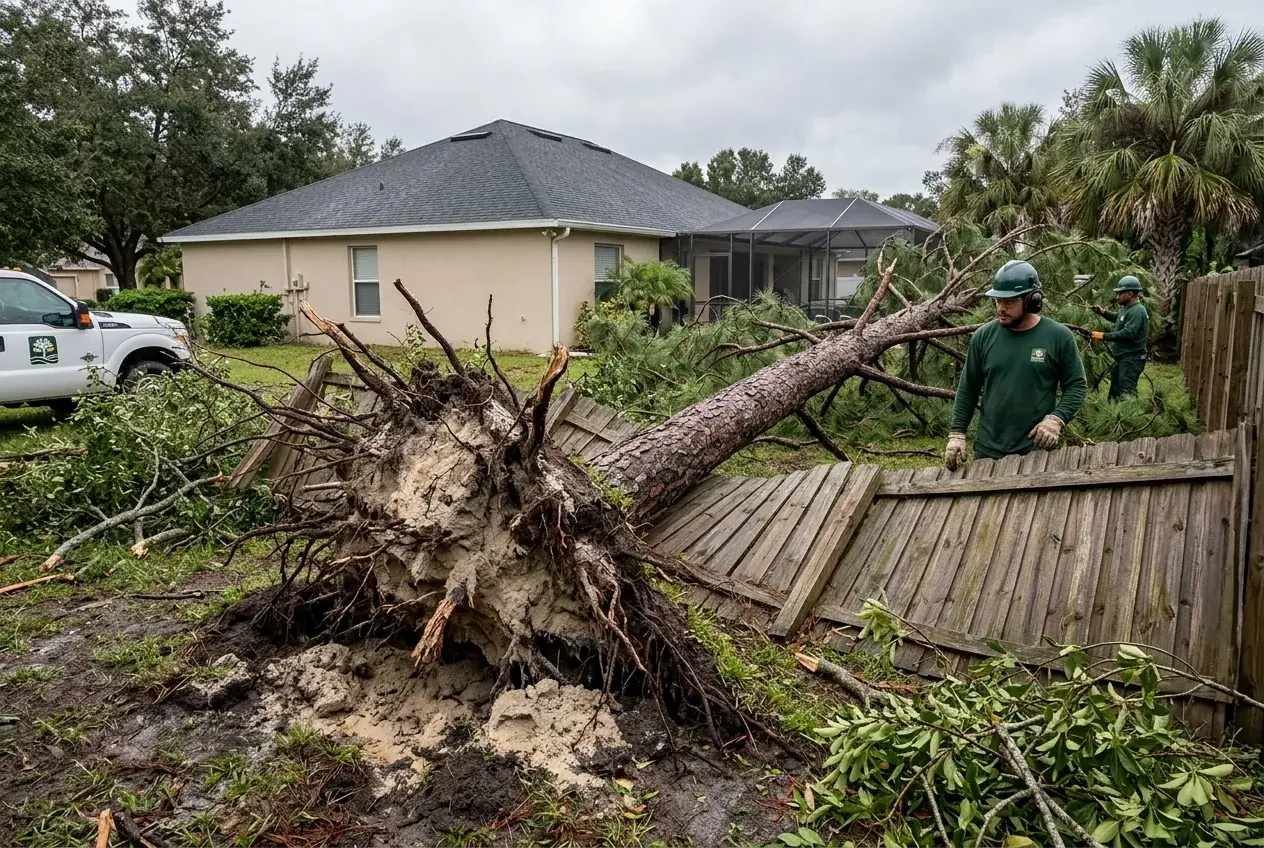
Before anyone cuts, take wide shots showing the whole tree and the house, then close-ups of every point of contact: roof, gutters, fence, vehicle, enclosure. Photograph the root plate or broken stump too, since that shows how the tree failed. We photograph storm damage for insurance before we start cutting, but your own photos taken right after the storm are valuable as well.
Sort what is urgent
A tree through a roof, blocking the only driveway, or leaning on the house needs immediate attention. Our emergency tree removal line runs 24/7 for exactly those calls. A tree down across the back lawn can wait for a regular appointment, which costs less. Our storm damage cleanup crews handle the backlog after the first wave of emergencies.
Storm Debris Rules in Lake County
After Milton, Lake County asked residents in unincorporated areas to keep vegetative debris, such as branches, trunks, stumps and leaves, separate from construction and demolition debris like damaged roofing, drywall or fencing. Vegetative debris was to be set out unbagged, and piles were not to block mailboxes or sit under power lines. The county also set a final curbside deadline for storm debris pickup.
Cities such as Clermont, Minneola and Groveland run their own collection programs, and the rules after each storm are announced locally. Check your city or the county's solid waste office before building a pile. When we do the work, the debris leaves with us, so you do not have to sort it or wait for a collection truck.
Watching Trees in the Months After a Hurricane
Not every storm-damaged tree fails right away. UF/IFAS researchers found that pines can show no visible damage right after high winds and then decline and die six months to two years later, sometimes turning yellow and then brown very quickly. After Hurricane Charley, they found 27 percent of standing south Florida slash pines and 48 percent of standing longleaf pines dead within three months.
Broadleaf trees that lose their leaves are not necessarily dead. UF/IFAS advises waiting to see if they leaf out again, usually within a few months or by the following spring. If a tree has not pushed new growth by early summer after the storm, it is unlikely to recover. For pines that start to brown, schedule pine tree removal before the dead wood becomes brittle.
Hurricane Prep for Clermont, Montverde and Groveland Properties
Larger lots in Montverde and the rural edges of Groveland often have stands of tall pines close to homes, while older neighborhoods around Downtown Clermont and Lake Minneola have more mature oaks. The checklist is the same either way: deal with dead and decayed trees first, then thin and reduce the healthy ones that overhang the house.
If removal is on the table, our guide to tree removal costs in Clermont shows what planned work typically runs compared with emergency calls.