
Trees on Clermont Hills: What Makes This Ground Different
Clermont and Minneola sit on the Lake Wales Ridge, the old sand ridge that runs down the middle of the Florida peninsula. Sugarloaf Mountain, just north of Clermont near Minneola, rises to 312 feet and is the highest point on the peninsula. Those hills are made of deep, loose sand laid down when seas covered much more of Florida than they do now.
The soil survey for Lake County maps much of the upland ridge as Candler sand and similar soils. Reports drawing on that survey describe Candler sand as excessively drained, with rapid permeability, very low available water capacity and a water table well below the surface. In plain terms, water runs straight through it and nutrients go with it.
How Sandy Soil in Clermont Shapes Tree Roots
Trees in deep sand do not grow the way people picture, with a taproot holding them in place like a stake. Most of a tree's working roots sit in the upper layer of soil, where oxygen and water are, and they spread well past the edge of the canopy. In ridge sand, that upper layer is where the organic matter, mulch and irrigation water end up, so roots crowd into it.
Shallow lateral roots
Many Clermont trees form wide, flat root systems that run sideways for long distances. That works fine in calm weather. It is the reason a tree can lift out of the ground as a single disc of roots and sand, called a root plate failure, when wind hits after a soaking rain.
Irrigation habits matter
Short, frequent sprinkler cycles keep only the top inch or two of sand moist, which trains roots to stay right at the surface. Watering turf daily also keeps the zone around tree roots wet in a way the native ridge vegetation never experienced. Fewer, deeper waterings on the schedule your water provider allows encourage roots to go down instead of only out.
Drought stress shows up fast
Low water-holding capacity means trees here run dry quickly in the spring dry season. Stressed trees are more open to borers and decay fungi. A layer of mulch over the root zone, kept off the trunk itself, holds moisture and adds the organic matter ridge sand lacks.

Native Ridge Trees vs. Yard Trees in Clermont
Before the groves and the subdivisions, much of this ridge carried sandhill and scrub: longleaf pine, turkey oak, sand live oak and other scrubby oaks adapted to dry, poor sand. Those species are built for the ground. Turkey oak and sand live oak sit in the highest wind-resistance group in UF/IFAS hurricane research, and both tolerate long dry spells without irrigation.
Many yard trees came from somewhere else. Laurel oaks and water oaks naturally favor moister sites, and on a dry ridge lot they depend on sprinklers to stay vigorous. Camphor, an invasive tree, seeds into fence lines and old grove edges all over South Lake. When one of those trees declines on a sandy hilltop, the soil is often part of the reason, and a ridge-adapted replacement usually does better.
Slopes, Erosion and Tree Stability in Clermont
On a sloped lot, sand moves. Heavy summer storms wash it downhill and expose roots on the upper side of a tree. Over years, that can leave a tree standing on a pedestal of roots with much less soil holding it than it had when it was planted. Lake-facing lots around the Clermont Chain of Lakes and the slopes near Minneola see this often.
- Watch for roots that were once buried and are now bare and gray on the uphill side.
- Look for a lean that grows downhill over time.
- Check for gullies forming where downspouts or driveways send water toward the tree.
- Notice cracks opening in the soil on the uphill side after storms, which can mean roots are pulling.
Redirecting runoff, mulching bare sand and planting groundcover on the slope do more for an eroding tree than piling fresh fill dirt over exposed roots. Adding several inches of soil over roots can cut off oxygen and cause its own decline.
Construction Damage to Trees in New Clermont Subdivisions
The State Archives of Florida notes that by the 1980s, freezes and disease had wiped out most of the area's citrus groves and subdivisions replaced them. That pattern continues today across South Lake, with new neighborhoods going in on former grove and pasture land along the US-27 and SR-50 corridors. Builders often leave a few existing oaks or pines for curb appeal, and those trees take a beating during construction.
What hurts retained trees
- Grading that cuts away roots on one side or buries the root flare under fill.
- Trenching for irrigation, water, sewer and electrical lines through the root zone.
- Heavy equipment compacting loose sand around the trunk.
- Pool excavation and pool-cage footers placed close to an existing tree.
- Concrete washout and material stockpiles left under the canopy.
Root damage from construction often takes several years to show up as thinning canopy and dieback, long after the builder is gone. A tree that lost roots on one side to a trench or slab is also more likely to fall toward the side with intact roots, often onto the new house.
Trees planted by the builder
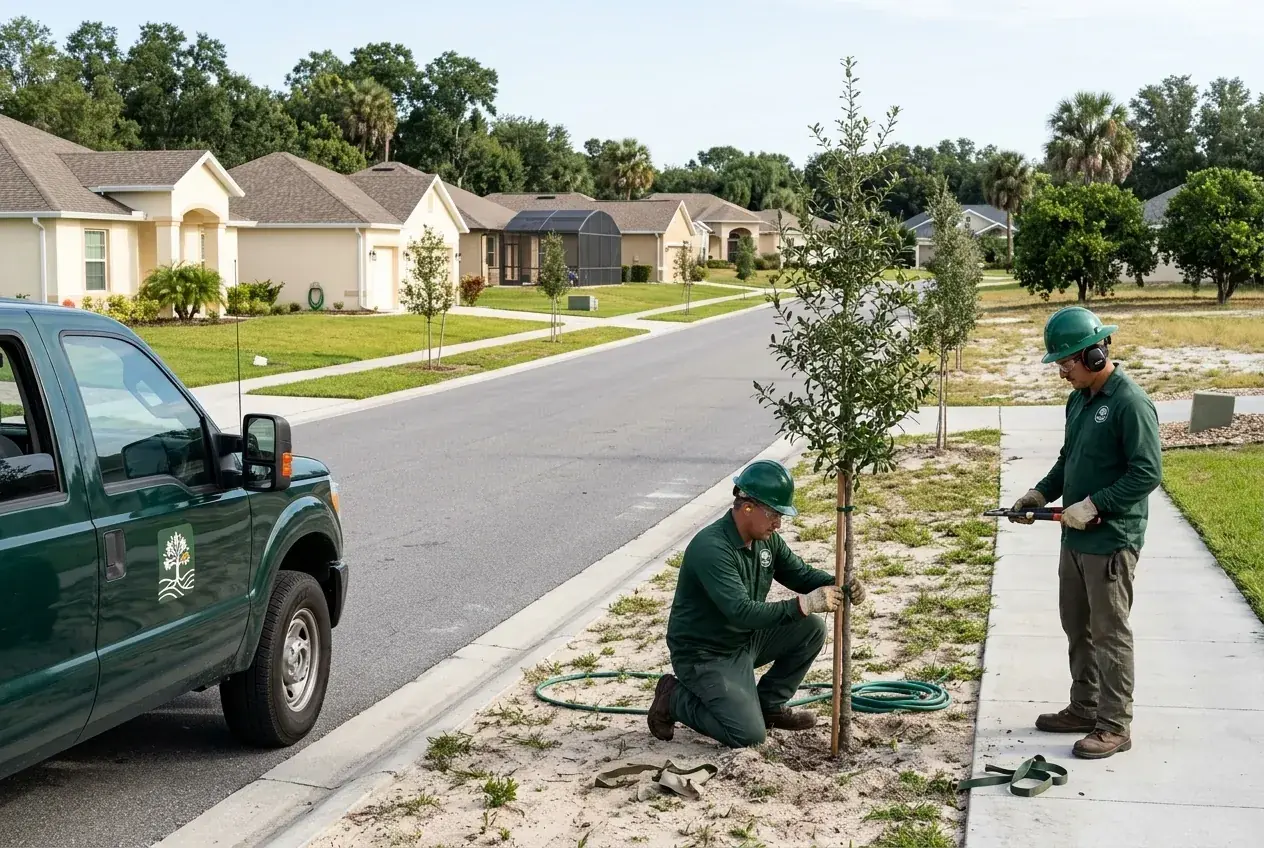
Young street and yard trees in new neighborhoods have the opposite problem: small root balls in compacted fill, sometimes in narrow strips between sidewalk and curb. UF/IFAS recommends at least 10 by 10 feet of rooting space for small trees, 20 by 20 feet for medium trees and 30 by 30 feet for large ones. Narrow planting strips rarely meet that, which is one reason those trees struggle.
Tree Problems Near Pools and Foundations on Sandy Lots
In loose sand, roots travel easily toward water and loose fill. Pool decks, irrigation leaks and the backfill around a foundation are easy targets. Surface roots can lift pavers and crack thin slabs. Cutting those roots to fix the hardscape removes support, so the decision to root-prune a big tree should be made carefully. Sometimes removing the tree and replanting something smaller farther from the house is the safer long-term choice.
Clermont Tree Care for Sandy, Hilly Lots
A few habits go a long way on ridge soil:
- Mulch wide rings around trees and keep mulch a few inches off the trunk.
- Water deeply and less often within local watering rules.
- Keep vehicles, trailers and equipment off the root zone.
- Have large trees near the house looked at after any construction or trenching.
- Prune deadwood and reduce heavy limbs on trees growing on slopes.
Regular tree trimming and pruning keeps weight off weakened root systems. If a tree has already lost too much support, tree removal before storm season is cheaper than a tree on the roof afterward. Old grove leftovers on new lots are a common call too, and our citrus tree removal page and post on dead citrus trees in Lake County cover those.
Sandy Soil Tree Issues in South Clermont and Horizon West
Newer homes in South Clermont and along US-27 and across the county line in Horizon West share the same story: rolling sand, recently graded lots and trees that are either very young or survivors of construction. If you are replacing a tree on one of those lots, our guide to the best trees to plant in Clermont after a removal focuses on species that tolerate dry sand and stand up to wind. For storm-season prep on these soils, see our hurricane tree prep guide.